While I’m fascinated by cases where the frequencies of two, or ten, or twenty words closely parallel each other, my conscience has also been haunted by a problem with trend-mining — which is that it always works. There are so many words in the English language that you’re guaranteed to find groups of them that correlate, just as you’re guaranteed to find constellations in the night sky. Statisticians call this the problem of “multiple comparisons”; it rests on a fallacy that’s nicely elucidated in this classic xkcd comic about jelly beans.
Simply put: it feels great to find two conceptually related words that correlate over time. But we don’t know whether this is a significant find, unless we also know how many potentially related words don’t correlate.
One way to address this problem is to separate the process of forming hypotheses from the process of testing them. For instance, we could use topic modeling to divide the lexicon up into groups of terms that occur in the same contexts, and then predict that those terms will also correlate with each other over time. In making that prediction, we turn an undefined universe of possible comparisons into a finite set.
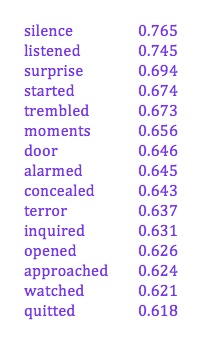
Once you create a set of topics, plotting their frequencies is simple enough. But plotting the aggregate frequency of a group of words isn’t the same thing as “discovering a trend,” unless the individual words in the group actually correlate with each other over time. And it’s not self-evident that they will. The top 15 words in topic #91, "Silence/Listened," and their cosine similarity to the centroid.
So I decided to test the hypothesis that they would. I used semi-fuzzy clustering to divide one 18c collection (TCP-ECCO) into 200 groups of words that tend to appear in the same volumes, and then tested the coherence of those topics over time in a different 18c collection (a much-cleaned-up version of the Google ngrams dataset I produced in collaboration with Loretta Auvil and Boris Capitanu at the NCSA). Testing hypotheses in a different dataset than the one that generated them is a way of ensuring that we aren’t simply rediscovering the same statistical accidents a second time.
To make a long story short, it turns out that topics have a statistically significant tendency to be trends (at least when you’re working with a century-sized domain). Pairs of words selected from the same topic correlated significantly with each other even after factoring out other sources of correlation*; the Fisher weighted mean r for all possible pairs was 0.223, which measured over a century (n = 100) is significant at p < .05.
In practice, the coherence of different topics varied widely. And of course, any time you test a bunch of hypotheses in a row you're going to get some false positives. So the better way to assess significance is to control for the "false discovery rate." When I did that (using the Benjamini-Hochberg method) I found that 77 out of the 200 topics cohered significantly as trends.
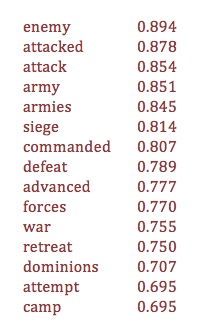
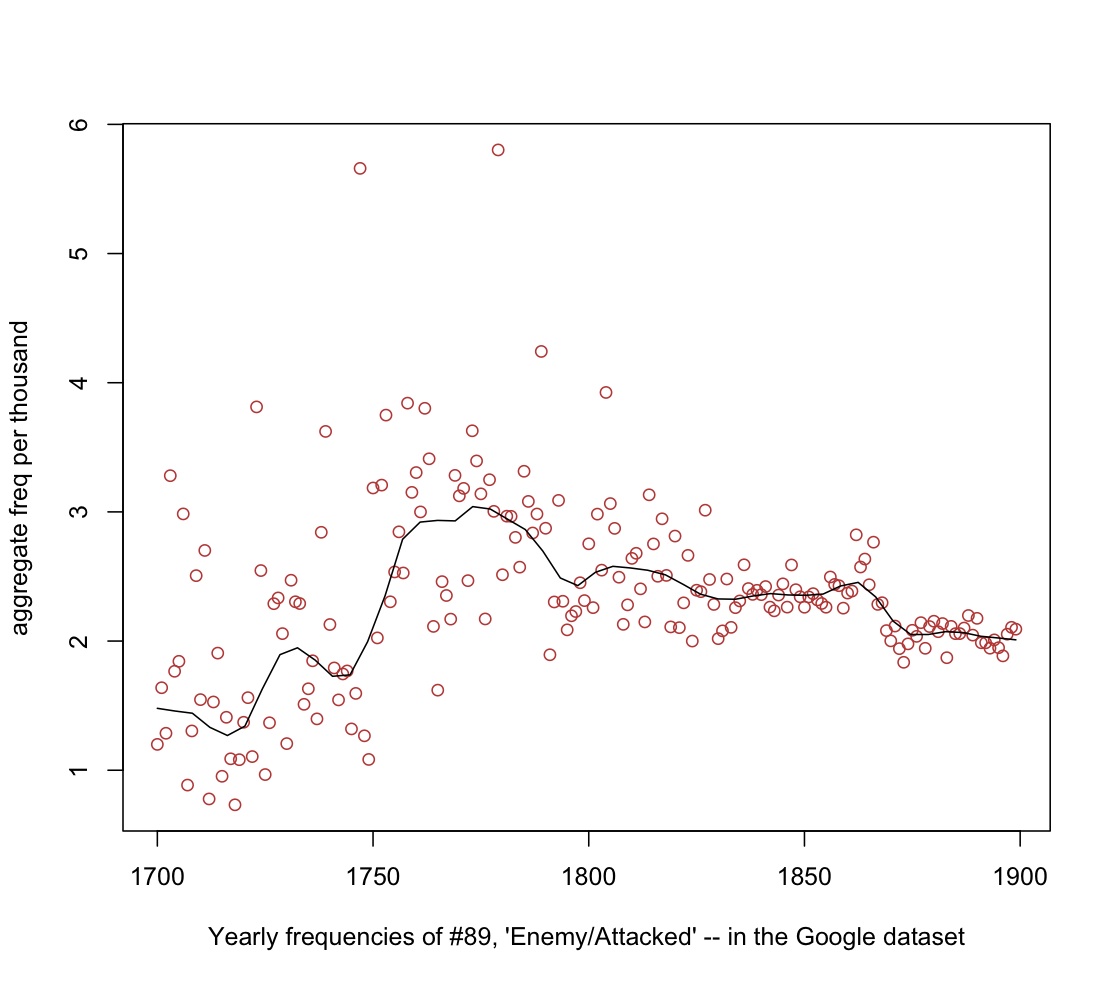
There are a lot of technical details, but I'll defer them to a footnote at the end of this post. What I want to emphasize first is the practical significance of the result for two different kinds of researchers. If you're interested in mining diachronic trends, then it may be useful to know that topic-modeling is a reliable way of discovering trends that have real statistical significance and aren’t just xkcd’s “green jelly beans.” The top 15 terms in topic #89, "Enemy/Attacked," and their cosine similarity to the centroid.
Conversely, if you're interested in topic modeling, it may be useful to know that the topics you generate will often be bound together by correlation over time as well. (In fact, as I’ll suggest in a moment, topics are likely to cohere as trends beyond the temporal boundaries of your collection!)
Finally, I think this result may help explain a phenomenon that Ryan Heuser, Long Le-Khac, and I have all independently noticed: which is that groups of words that correlate over time in a given collection also tend to be semantically related. I've shown above that topic modeling tends to produce diachronically coherent trends. I suspect that the converse proposition is also true: clusters of words linked by correlation over time will turn out to have a statistically significant tendency to appear in the same contexts.
Why are topics and trends so closely related? Well, of course, when you’re topic-modeling a century-long collection, co-occurrence has a diachronic dimension to start with. So the boundaries between topics may already be shaped by change over time. It would be interesting to factor time out of the topic-modeling process, in order to see whether rigorously synchronic topics would still generate diachronic trends.
I haven’t tested that yet, but I have tried another kind of test, to rule out the possibility that we’re simply rediscovering the same trends that generated the topics in the first place. Since the Google dataset is very large, you can also test whether 18c topics continue to cohere as trends in the nineteenth century. As it turns out, they do — and in fact, they cohere slightly more strongly! (In the 19c, 88 out of 200 18c topics cohered significantly as trends.) The improvement is probably a clue that Google’s dataset gets better in the nineteenth century (which god knows, it does) — but even if that’s true, the 19c result would be significant enough on its own to show that topic modeling has considerable predictive power.
Practically, it’s also important to remember that “trends” can play out on a whole range of different temporal scales.
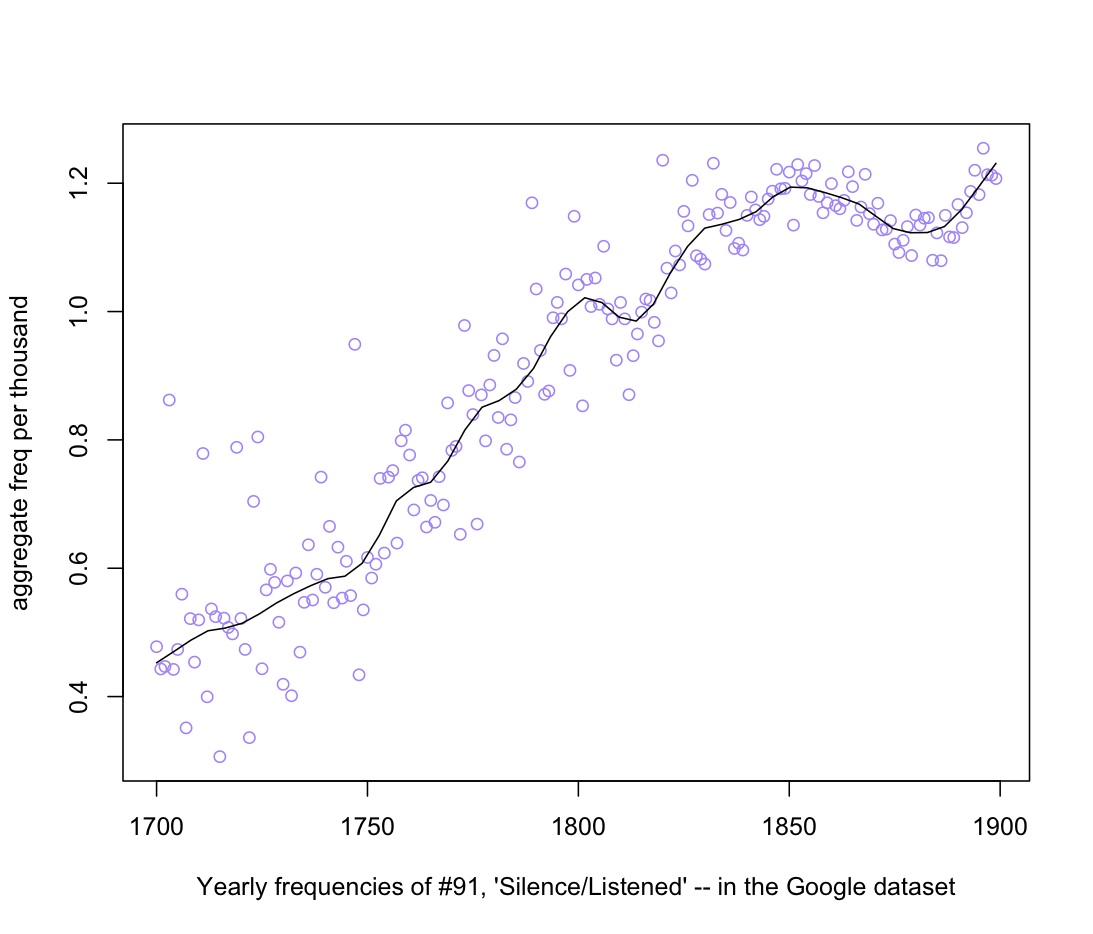
For instance, here’s the trend curve for topic #91, “Silence / Listened,” which is linked to the literature of suspense, and increases rather gradually and steadily from 1700 to the middle of the nineteenth century.
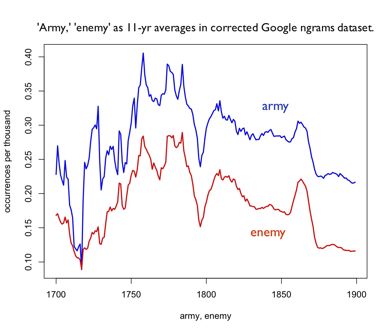
By contrast, here’s the trend curve for topic #89, “Enemy/Attacked,” which is largely used in describing warfare. It doesn’t change frequency markedly from beginning to end; instead it bounces around from decade to decade with a lot of wild outliers. But it is in practice a very tightly-knit trend: a pair of words selected from this topic will have on average 31% of their variance in common. The peaks and outliers are not random noise: they’re echoes of specific armed conflicts.
* Technical details: Instead of using Latent Dirichlet Allocation for topic modeling, I used semi-fuzzy c-means clustering on term vectors, where term vectors are defined in the way I describe in this technical note. I know LDA is the standard technique, and it seems possible that it would perform even better than my clustering algorithm does. But in a sufficiently large collection of documents, I find that a clustering algorithm produces, in practice, very coherent topics, and it has some other advantages that appeal to me. The “semi-fuzzy” character of the algorithm allows terms to belong to more than one cluster, and I use cosine similarity to the centroid to define each term’s “degree of membership” in a topic.
I only topic-modeled the top 5000 words in the TCP-ECCO collection. So in measuring pairwise correlations of terms drawn from the same topic, I had to calculate it as a partial correlation, controlling for the fact that terms drawn from the top 5k of the lexicon are all going to have, on average, a slight correlation with each other simply by virtue of being drawn from that larger group.
Having just returned from a conference of Romanticists, I’m in a mood to reflect a bit about the relationship between text mining and the broader discipline of literary studies. This entry will be longer than my usual blog post, because I think I’ve got an argument to make that demands a substantial literary example. But you can skip over the example to extract the polemical thesis if you like!
At the conference, I argued that literary critics already practice a crude form of text mining, because we lean heavily on keyword search when we’re tracing the history of a topic or discourse. I suggested that information science can now offer us a wider range of tools for mapping archives — tools that are subtler, more consonant with our historicism, and maybe even more literary than keyword search is.
At the same time, I understand the skepticism that many literary critics feel. Proving a literary thesis with statistical analysis is often like cracking a nut with a jackhammer. You can do it: but the results are not necessarily better than you would get by hand.
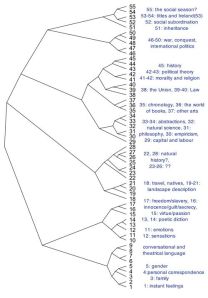
One obvious solution would be to use text mining in an exploratory way, to map archives and reveal patterns that a critic could then interpret using nuanced close reading. I’m finding that approach valuable in my own critical practice, and I’d like to share an example of how it works. But I also want to reflect about the social forces that stand in the way of this obvious compromise between digital and mainstream humanists — leading both sides to assume that quantitative analysis ought to contribute instead by proving literary theses with increased certainty. Part of a topic tree based on a generically diverse collection of 2200 18c texts.
I’ll start with an example. If you don’t believe text mining can lead to literary insights, bear with me: this post starts with some goofy-looking graphs, but develops into an actual hypothesis about the Romantic novel based on normal kinds of literary evidence. But if you’re willing to take my word that text-mining can produce literary leads, or simply aren’t interested in Romantic-era fiction, feel free to skip to the end of this (admittedly long!) post for the generalizations about method.
Several months ago, when I used hierarchical clustering to map eighteenth-century diction on this blog, I pointed to a small section of the resulting tree that intriguingly mixed language about feeling with language about time. It turned out that the words in this section of the tree were represented strongly in late-eighteenth-century novels (novels, for instance, by Frances Burney, Sophia Lee, and Ann Radcliffe). Other sections of the tree, associated with poetry or drama, had a more vivid kind of emotive language, and I wondered why novels would combine an emphasis on feeling or exclamation (“felt,” “cried”) with the abstract topic of duration (“moment,” “longer”). It seemed an oddly phenomenological way to think about emotion.
But I also realized that hierarchical clustering is a fairly crude way of mapping conceptual space in an archive. The preferred approach in digital humanities right now is topic modeling, which does elegantly handle problems like polysemy. However, I’m not convinced that existing methods of topic modeling (LDA and so on) are flexible enough to use for exploration. One of their chief advantages is that they don’t require the human user to make judgment calls: they automatically draw boundaries around discrete “topics.” But for exploratory purposes boundaries are not an advantage! In exploring an archive, the goal is not to eliminate ambiguity so that judgment calls are unnecessary: the goal is to reveal intriguing ambiguities, so that the human user can make judgments about them.
If this is our goal, it’s probably better to map diction as an associative web. Fortunately, it was easy to get from the tree to a web, because the original tree had been based on an algorithm that measured the strength of association between any two words in the collection. Using the same algorithm, I created a list of twenty-five words most strongly associated with the branch that had interested me (“instantly,” “cried,” “felt,” moment,” “longer,”) and then used the strengths of association between those words to model the whole list as a force-directed graph. In this graph, words are connected by “springs” that pull them closer together; the darker the line, the stronger the association between the two words, and the more tightly they will be bound together in the graph. (The sizes of words are loosely proportional to their frequency in the collection, but only very loosely.)
A graph like this is not meant to be definitive: it’s a brainstorming tool that helps me explore associations in a particular collection (here, a generically diverse collection of eighteenth-century writing). On the left side, we see a triangle of feminine pronouns (which are strongly represented in the same novels where “felt,” “moment,” and so on are strongly represented) as well as language that defines domestic space (“quitting,” “room”). On the right side of the graph, we see a range of different kinds of emotion. And yet, looking at the graph as a whole, there is a clear emphasis on an intersection of feeling and time — whether the time at issue is prospective (“eagerly,” “hastily,” “waiting”) or retrospective (“recollected,” “regret”).
In particular, there are a lot of words here that emphasize temporal immediacy, either by naming a small division of time (“moment,” “instantly”), or by defining a kind of immediate emotional response (“surprise,” “shocked,” “involuntarily”). I have highlighted some of these words in red; the decision about which words to include in the group was entirely a human judgment call — which means that it is open to the same kind of debate as any other critical judgment.
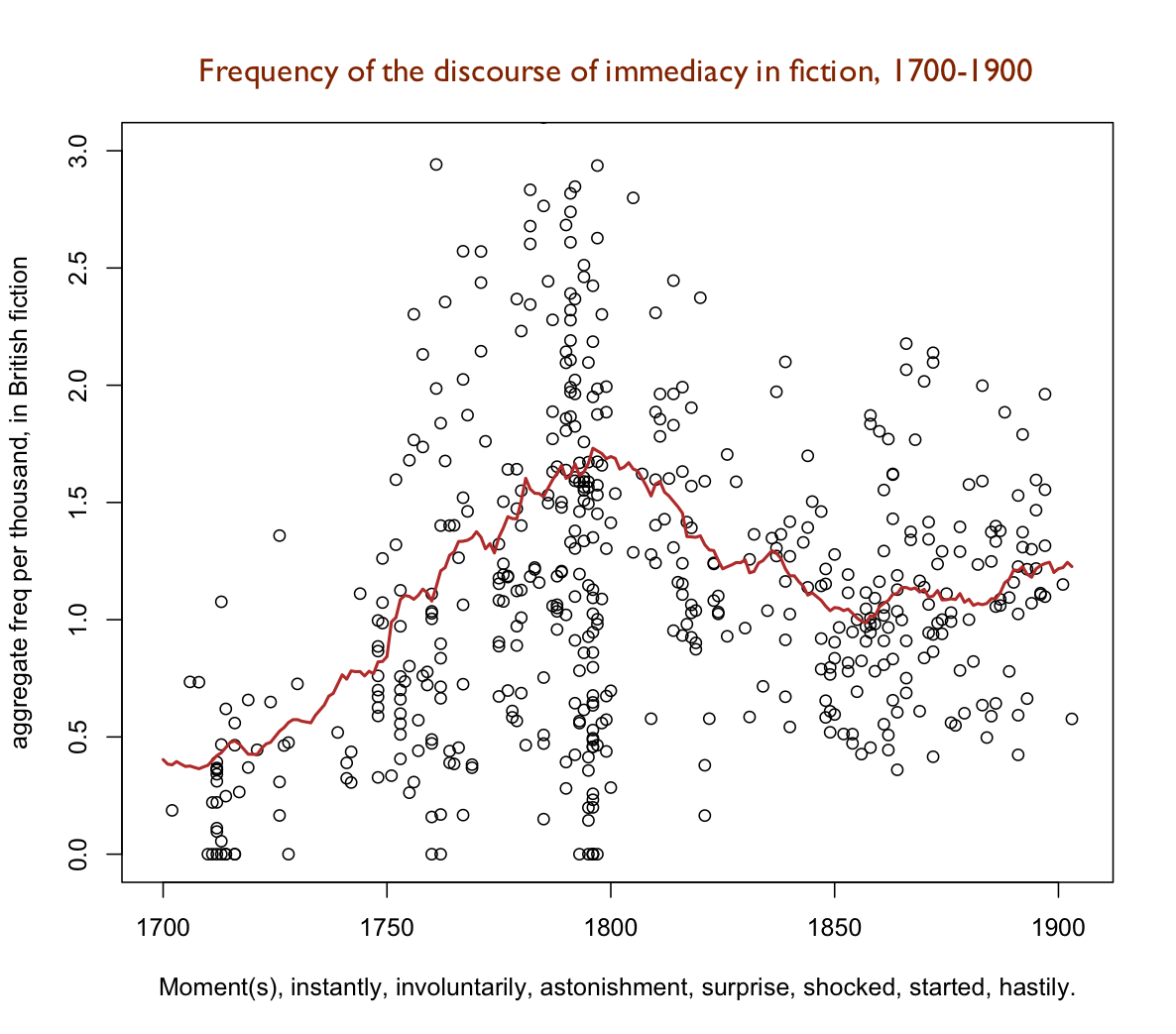
But the group of words I have highlighted in red — let’s call it a discourse of temporal immediacy — does turn out to have an interesting historical profile. We already know that this discourse was common in late-eighteenth-century novels. But we can learn more about its provenance by restricting the generic scope of the collection (to fiction) and expanding its temporal scope to include the nineteenth as well as eighteenth centuries. Here I’ve graphed the aggregate frequency of this group of words in a collection of 538 works of eighteenth- and nineteenth-century fiction, plotted both as individual works and as a moving average. [The moving average won’t necessarily draw a line through the center of the “cloud,” because these works vary greatly in size. For instance, the collection includes about thirty of Hannah More’s “Cheap Repository Tracts,” which are individually quite short, and don’t affect the moving average more than a couple of average-sized novels would, although they create an impressive stack of little circles in the 1790s.]
The shape of the curve here suggests that we’re looking at a discourse that increased steadily in prominence through the eighteenth century and peaked (in fiction) around the year 1800, before sinking back to a level that was still roughly twice its early-eighteenth-century frequency.
Why might this have happened? It’s always a good idea to start by testing the most boring hypothesis — so a first guess might be that words like “moment” and “instantly” were merely displacing some set of close synonyms. But in fact most of the imaginable synonyms for this set of words correlate very closely with them. (This is true, for instance, of words like “sudden,” “abruptly,” and “alarm.”)
Another way to understand what’s going on would be to look at the works where this discourse was most prominent. We might start by focusing on the peak between 1780 and 1820. In this period, the works of fiction where language of temporal immediacy is most prominent include
Charlotte Dacre, Zofloya (1806)
Charlotte Lennox, Hermione, or the Orphan Sisters (1791)
M. G. Lewis, The Monk (1796)
Ann Radcliffe, A Sicilian Romance (1790), The Castles of Athlin and Dunbayne (1789), and The Romance of the Forest (1792)
Frances Burney, Cecilia (1782) and The Wanderer (1814)
Amelia Opie, Adeline Mowbray (1805)
Sophia Lee, The Recess (1785)
There is a strong emphasis here on the Gothic, but perhaps also, more generally, on women writers. The works of fiction where the same discourse is least prominent would include
Hannah More, most of her “Cheap Repository Tracts” and Coelebs in Search of a Wife (1809)
Robert Bage, Hermsprong (1796)
John Trusler, Life; or the Adventures of William Ramble (1793)
Maria Edgeworth, Castle Rackrent (1800)
Arnaud Berquin, The Children’s Friend (1788)
Isaac Disraeli, Vaurien; or, Sketches of the Times (1797)
Many of these works are deliberately old-fashioned in their approach to narrative form: they are moral parables, or stories for children, or first-person retrospective narratives (like Rackrent), or are told by Fieldingesque narrators who feel free to comment and summarize extensively (as in the works by Disraeli and Trusler).
After looking closely at the way the language of temporal immediacy is used in Frances Burney, Cecilia (1782), and Sophia Lee, The Recess (1785), it seems to me that it had both a formal and an affective purpose.
Formally, it foregrounded a newly sharp kind of temporal framing. If we believe Ian Watt, part of the point of the novel form is to emulate the immediacy of first-hand experience — a purpose that can be slightly at odds with the retrospective character of narrative. Eighteenth-century novelists fought the distancing effect of retrospection in a lot of ways: epistolary narrative, discovered journals and so on are ways of bringing the narrative voice as close as possible to the moment of experience. But those tricks have limits; at some point, if your heroine keeps running off to write breathless letters between every incident, Henry Fielding is going to parody you.
By the late eighteenth century it seems to me novelists were starting to work out ways of combining temporal immediacy with ordinary retrospective narration. Maybe you can’t literally have your narrator describe events as they’re taking place, but you can describe events in a way that highlights their temporal immediacy. This is one of the things that makes Frances Burney read more like a nineteenth-century novelist than like Defoe; she creates a tight temporal frame for each event, and keeps reminding her readers about the tightness of the frame. So, a new paragraph will begin “A few moments after he was gone …” or “At that moment Sir Robert himself burst into the Room …” or “Cecilia protested she would go instantly to Mr Briggs,” to choose a few examples from a single chapter of Cecilia (my italics, 363-71). We might describe this vaguely as a way of heightening suspense — but there are of course many different ways to produce suspense in fiction. Narratology comes closer to the question at issue when it talks about “pacing,” but unless someone has already coined a better term, I think I would prefer to describe this late-18c innovation as a kind of “temporal framing,” because the point is not just that Burney uses “scene” rather than “summary” to make discourse time approximate story time — but that she explicitly divides each “scene” into a succession of discrete moments.
There is a lot more that could be said about this aspect of narrative form. For one thing, in the Romantic era it seems related to a particular way of thinking about emotion — a strategy that heightens emotional intensity by describing experience as if it were divided into a series of instananeous impressions. E.g, “In the cruelest anxiety and trepidation, Cecilia then counted every moment till Delvile came …” (Cecilia, 613). Characters in Gothic fiction are “every moment expecting” some start, shock, or astonishment. “The impression of the moment” is a favorite phrase for both Burney and Sophia Lee. On one page of The Recess, a character “resign[s] himself to the impression of the moment,” although he is surrounded by a “scene, which every following moment threatened to make fatal” (188, my italics).
In short, fairly simple tools for mapping associations between words can turn up clues that point to significant formal, as well as thematic, patterns. Maybe I’m wrong about the historical significance of those patterns, but I’m pretty sure they’re worth arguing about in any case, and I would never have stumbled on them without text mining.
On the other hand, when I develop these clues into a published article, the final argument is likely to be based largely on narratology and on close readings of individual texts, supplemented perhaps by a few simple graphs of the kind I’ve provided above. I suppose I could master cutting-edge natural language processing, in order to build a fabulous tool that would actually measure narrative pace, and the division of scenes into incidents. That would be fun, because I love coding, and it would be impressive, since it would prove that digital techniques can produce literary evidence. But the thing is, I already have an open-source application that can measure those aspects of narrative form, and it runs on inexpensive hardware that requires only water, glucose, and caffeine.
The methodological point I want to make here is that relatively simple forms of text mining, based on word counts, may turn out to be the techniques that are in practice most useful for literary critics. Moreover, if I can speak frankly: what makes this fact hard for us to acknowledge is not technophilia per se, but the nature of the social division between digital humanists and mainstream humanists. Literary critics who want to dismiss text mining are fond of saying “when you get right down to it, it’s just counting words.” (At moments like this we seem to forget everything 20c literary theorists ever learned from linguistics, and go back to treating language as a medium that ideally, ought to be immaterial and transparent. Surely a crudely verbal approach — founded on lumpy, ambiguous words — can never tell us anything about the conceptual subtleties of form and theme!) Stung by that critique, digital humanists often feel we have to prove that our tools can directly characterize familiar literary categories, by doing complex analyses of syntax, form, and sentiment.
I don’t want to rule out those approaches; I’m not interested in playing the game “Computers can never do X.” They probably can do X. But we’re already carrying around blobs of wetware that are pretty good at understanding syntax and sentiment. Wetware is, on the other hand, terrible at counting several hundred thousand words in order to detect statistical clues. And clues matter. So I really want to urge humanists of all stripes to stop imagining that text mining has to prove its worth by proving literary theses.
That should not be our goal. Full-text search engines don’t perform literary analysis at all. Nor do they prove anything. But literary scholars find them indispensable: in fact, I would argue that search engines are at least partly responsible for the historicist turn in recent decades. If we take the same technology used in those engines (a term-document matrix plus vector space math), and just turn the matrix on its side so that it measures the strength of association between terms rather than documents, we will have a new tool that is equally valuable for literary historians. It won’t prove any thesis by itself, but it can uncover a whole new range of literary questions — and that, it seems to me, ought to be the goal of text mining.
References
Frances Burney, Cecilia; or, Memoirs of an Heiress, ed. Peter Sabor and Margaret Ann Doody (Oxford: OUP, 1999).
Sophia Lee, The Recess; or, a Tale of Other Times, ed. April Alliston (Lexington: UP of Kentucky, 2000).
[Postscript: This post, originally titled “How to make text mining serve literary history,” is a version of a talk I gave at NASSR 2011 in Park City, Utah, sharpened by the discussion that took place afterward. I’d like to thank the organizers of the conference (Andrew Franta and Nicholas Mason) as well as my co-panelists (Mark Algee-Hewitt and Mark Schoenfield) and everyone in the audience. The original slides are here; sometimes PowerPoint can be clearer than prose.
I don’t mean to deny, by the way, that the simple tools I’m using could be refined in many ways — e.g., they could include collocations. What I’m saying is I that don’t think we need to wait for technical refinements. Our text-mining tools are already sophisticated enough to produce valuable leads, and even after we make them more sophisticated, it will remain true that at some point in the critical process we have to get off the bicycle and walk.]
I should say up front that this is going to be a geeky post about things that happen under the hood of the car. Many readers may be better served by scrolling down to “Trends, topics, and trending topics,” which has more to say about the visible applications of text mining.
I’ve developed a clustering methodology that I like pretty well. It allows me to map patterns of usage in a large collection by treating each term as a vector; I assess how often words occur together by measuring the angle between vectors, and then group the words with Ward’s clustering method. This produces a topic tree that seems to be both legible (in the sense that most branches have obvious affinities to a genre or subject category) and surprising (in the sense that they also reveal thematic connections I wouldn’t have expected). It’s a relatively simple technique that does what I want to do, practically, as a literary historian. (You can explore this map of eighteenth-century diction to check it out yourself; and I should link once again to Sapping Attention, which convinced me clustering could be useful.)
But as I learn more about Bayesian statistics, I’m coming to realize that it’s debatable whether the clusters of terms I’m finding count as topics at all. The topic-modeling algorithms that have achieved wide acceptance (for instance, Latent Dirichlet Allocation) are based on a clear definition of what a “topic” is. They hypothesize that the observed complexity of usage patterns is actually produced by a smaller set of hidden variables. Because those variables can be represented as lists of words, they’re called topics. But the algorithm isn’t looking for thematic connections between words so much as resolving a collection into a set of components or factors that could have generated it. In this sense, it’s related to a technique like Principal Component Analysis.
Deriving those hidden variables is a mathematical task of considerable complexity. In fact, it’s impossible to derive them precisely: you have to estimate. I can only understand the math for this when my head is constantly bathed in cool running water to keep the processor from overheating, so I won’t say much more about it — except that “factoring” is just a metaphor I’m using to convey the sort of causal logic involved. The actual math involves Bayesian inference rather than algebra. But it should be clear, anyway, that this is completely different from what I’m doing. My approach isn’t based on any generative model, and can’t claim to reveal the hidden factors that produce texts. It simply clusters words that are in practice associated with each other in a corpus.
I haven’t tried the Bayesian approach yet, but it has some clear advantages. For one thing, it should work better for purposes of classification and information retrieval, because it’s looking for topics that vary (at least in principle) independently of each other.* If you want to use the presence of a topic in a document to guide classification, this matters. A topic that correlated positively or negatively with another topic would become redundant; it wouldn’t tell you much you didn’t already know. It makes sense to me that people working in library science and information retrieval have embraced an approach that resolves a collection into independent variables, because problems of document classification are central to those disciplines.
On the other hand, if you’re interested in mapping associations between terms, or topics, the clustering approach has advantages. It doesn’t assume that topics vary independently. On the contrary, it’s based on a measure of association between terms that naturally extends to become a measure of association between the topics themselves. The clustering algorithm produces a branching tree structure that highlights some of the strongest relationships and contrasts, but you don’t have to stop there: any list of terms can be treated as a vector, and compared to any other list of terms. A fragment of a larger tree, produced by clustering the top 1650 terms in a collection of 2,193 18c documents. Click through for a larger image giving more context.
Moreover, this flexibility means that you don’t have to treat the boundaries of “topics” as fixed. For instance, here’s part of the eighteenth-century tree that I found interesting: the words on this branch seemed to imply a strange connection between temporality and feeling, and they turned out to be particularly common in late-eighteenth-century novels by female writers. Intriguing, but we’re just looking at five words. Maybe the apparent connection is a coincidence. Besides, “cried” is ambiguous; it can mean “exclaimed” in this period more often than it means “wept.” How do we know what to make of a clue like this? Well, given the nature of the vector space model that produced the tree, you can do this: treat the cluster of terms itself as a vector, and look for other terms that are strongly related to it. When I did that, I got a list that confirmed the apparent thematic connection, and helped me begin to understand it. A list of terms most strongly associated with the group "instantly, cried, felt, moment, longer" in a generically diverse corpus of 2,193 18c documents ranging from sermons to cookbooks. "Similarity" here is technically measured as the cosine of the angle between two vectors.
This is, very definitely, a list of words associated with temporality (moment, hastily, longer, instantly, recollected) and feeling (felt, regret, anxiety, astonishment, agony). Moreover, it’s fairly clear that the common principle uniting them is something like “suspense” (waiting, eagerly, impatiently, shocked, surprise). Gender is also involved — which might not have been immediately evident from the initial cluster, because gendered words were drawn even more strongly to other parts of the tree. But the associational logic of the clustering process makes it easy to treat topic boundaries as porous; the clusters that result don’t have to be treated as rigid partitions; they’re more appropriately understood as starting-places for exploration of a larger associational web.
[This would incidentally be my way of answering a valid critique of clustering — that it doesn’t handle polysemy well. The clustering algorithm has to make a choice when it encounters a word like “cried.” The word might in practice have different sets of associations, based on different uses (weep/exclaim), but it’s got to go in one branch or another. It can’t occupy multiple locations in the tree. We could try to patch that problem, but I think it may be better to realize that the problem isn’t as important as it appears, because the clusters aren’t end-points. Whether a term is obviously polysemous, or more subtly so, we’re always going to need to make a second pass where we explore the associations of the cluster itself in order to shake off the artificiality of the tree structure, and get a richer sense of multi-dimensional context. When we do that we’ll pick up words like “herself,” which could justifiably be located at any number of places in the tree.]
Much of this may already be clear to people in informatics, but I had to look at the math in order to understand that different kinds of “topic modeling” are really doing different things. Humanists are going to have some tricky choices to make here that I’m not sure we understand yet. Right now the Bayesian “factoring” approach is more prominent, partly because the people who develop text-mining algorithms tend to work in disciplines where classification problems are paramount, and where it’s important to prove that they can be solved without human supervision. For literary critics and historians, the appropriate choice is less clear. We may sometimes be interested in classifying documents (for instance, when we’re reasoning about genre), and in that case we too may need something like Latent Dirichlet Allocation or Principal Component Analysis to factor out underlying generative variables. But we’re just as often interested in thematic questions — and I think it’s possible that those questions may be more intuitively, and transparently, explored through associational clustering. To my mind, it’s fair to call both processes “topic modeling” — but they’re exploring topics of basically different kinds.
Postscript: I should acknowledge that there are lots of ways of combining these approaches, either by refining LDA itself, or by combining that sort of topic-factoring approach with an associational web. My point isn’t that we have to make a final choice between these processes; I’m just reflecting that, in principle, they do different things.
I’ve developed a text-mining strategy that identifies what I call “trending topics” — with apologies to Twitter, where the term is used a little differently. These are diachronic patterns that I find practically useful as a literary historian, although they don’t fit very neatly into existing text-mining categories.
A “topic,” as the term is used in text-mining, is a group of words that occur together in a way that defines a thematic focus. Cameron Blevin’s analysis of Martha Ballard’s diary is often cited as an example: Blevin identifies groups of words that seem to be associated, for instance, with “midwifery,” “death,” or “gardening,” and tracks these topics over the course of the diary.
“Trends” haven’t received as much attention as topics, but we need some way to describe the pattern that Google’s ngram viewer has made so visible, where groups of related words rise and fall together across long periods of time. I suspect “trend” is as a good a name for this phenomenon as we’ll get. blue, red, green, yellow, in the English corpus 1750-2000
From 1750 to 1920, the prominence of color vocabulary increases by a factor of three, for instance: and when it does, the names of different colors track each other very closely. I would call this a trend. Moreover, it’s possible to extend the principle that conceptually related words rise and fall together beyond cases like the colors and seasons where we’re dealing with an obvious physical category.
Google data graphed with my own viewer; if you compare this to Google's viewer, remember that I'm merging capitalized and uncapitalized forms, as well as ardor/ardour.
“Animated,” “attentive,” and “ardour” track each other almost as closely as the names of primary colors (the correlation coefficients are around 0.8), and they characterize conduct in ways that are similar enough to suggest that we’re looking at the waxing and waning not just of a few random words, but of a conceptual category — say, a particular sort of interest in states of heightened receptiveness or expressivity.
I think we could learn a lot by thoughtfully considering “trends” of this sort, but it’s also a kind of evidence that’s not easy to interpret, and that could easily be abused. A lot of other words correlate almost as closely with “attentive,” including “propriety,” “elegance,” “sentiments,” “manners,” “flattering,” and “conduct.” Now, I don’t think that’s exactly a random list (these terms could all be characterized loosely as a discourse of manners), but it does cover more conceptual ground than I initially indicated by focusing on words like “animated” and “ardour.” And how do we know that any of these terms actually belonged to the same “discourse”? Perhaps the books that talked about “conduct” were careful not to talk about “ardour”! Isn’t it possible that we have several distinct discourses here that just happened to be rising and falling at the same time?
In order to answer these questions, I’ve been developing a technique that mines “trends” that are at the same time “topics.” In other words, I look for groups of terms that hold together both in the sense that they rise and fall together (correlation across time), and in the sense that they tend to be common in the same documents (co-occurrence). My way of achieving this right now is a two-stage process: first I mine loosely defined trends from the Google ngrams dataset (long lists of, say, one hundred closely correlated words), and then I send those trends to a smaller, generically diverse collection (including everything from sermons to plays) where I can break the list into clusters of terms that tend to occur in the same kinds of documents.
I do this with the same vector space model and hierarchical clustering technique I’ve been using to map eighteenth-century diction on a larger scale. It turns the list of correlated words into a large, branching tree. When you look at a single branch of that tree you’re looking at what I would call a “trending topic” — a topic that represents, not a stable, more-or-less-familiar conceptual category, but a dynamically-linked set of concepts that became prominent at the same time, and in connection with each other.
one branch of a tree created by finding words that correlate with "manners," and then clustering them based on co-occurrence in 18c books
Here, for instance, is a branch of a larger tree that I produced by clustering words that correlate with “manners” in the eighteenth century. It may not immediately look thematically coherent. We might have expected “manners” to be associated with words like “propriety” or “conduct” (which do in fact correlate with it over time), but when we look at terms that change in correlated ways and occur in the same volumes, we get a list of words that are largely about wealth and rank (“luxury,” “opulence,” “magnificence”), as well as the puzzling “enervated.” To understand a phenomenon like this, you can simply reverse the process that generated it, by using the list as a search query in the eighteenth-century collection it’s based on. What turned up in this case were, pre-eminently, a set of mid-eighteenth-century works debating whether modern commercial opulence, and refinements in the arts, have had an enervating effect on British manners and civic virtue. Typical examples are John Brown’s Estimate of the Manners and Principles of the Times (1757) and John Trusler’s Luxury no Political Evil but Demonstratively Proved to be Necessary to the Preservation and Prosperity of States (1781). I was dimly aware of this debate, but didn’t grasp how central it became to debate about manners, and certainly wasn’t familiar with the works by Brown and Trusler.
I feel like this technique is doing what I want it to do, practically, as a literary historian. It makes the ngram viewer something more than a provocative curiosity. If I see an interesting peak in a particular word, I can can map the broader trend of which it’s a part, and then break that trend up into intersecting discourses, or individual works and authors.
Admittedly, there’s something inelegant about the two-stage process I’m using, where I first generate a list of terms and then use a smaller collection to break the list into clusters. When I discussed the process with Ben Schmidt and Miles Efron, they both, independently, suggested that there ought to be some simpler way of distinguishing “trends” from “topics” in a single collection, perhaps by using Principal Component Analysis. I agree about that, and PCA is an intriguing suggestion. On the other hand, the two-stage process is adapted to the two kinds of collections I actually have available at the moment: on the one hand, the Google dataset, which is very large and very good at mapping trends with precision, but devoid of metadata, on the other hand smaller, richer collections that are good at modeling topics, but not large enough to produce smooth trend lines. I’m going to experiment with Principal Component Analysis and see what it can do for me, but in the meantime — speaking as a literary historian rather than a computational linguist — I’m pretty happy with this rough-and-ready way of identifying trending topics. It’s not an analytical tool: it’s just a souped-up search technology that mines trends and identifies groups of works that could help me understand them. But as a humanist, that’s exactly what I want text mining to provide.
Well, not really. But it is a classifying scheme that might turn out to be as loopy as Casaubon’s incomplete project in Middlemarch, and I thought I might embrace the comparison to make clear that I welcome skepticism.
In reality, it’s just a map of eighteenth-century diction. I took the 1,650 most common words in eighteenth-century writing, and asked my iMac to group them into clusters that tend to be common in the same eighteenth-century works. Since the clustering program works recursively, you end up with a gigantic branching tree that reveals how closely words are related to each other in 18c practice. If they appear on the same “branch”; they tend to occur in the same works. If they appear on the same “twig,” that tendency is even stronger.
You wouldn’t necessarily think that two words happening to occur in the same book would tell you much, but when you’re dealing with a large number of documents, it seems there’s a lot of information contained in the differences between them. In any case, this technique produced a detailed map of eighteenth-century topics that seemed — to me, anyway — surprisingly illuminating. To explore a couple of branches, or just marvel at this monument of digital folly, click here, or on the illustration to the right. That’ll take you through to a page where you can click on whichever branches interest you. (Click on the links in the right-hand margin, not the annotations on the tree itself.) To start with, I recommend Branch 18, which is a sort of travel narrative, Branch 13, which is 18c poetic diction in a nutshell, and Branch 5, which is saying something about gender and/or sexuality that I don’t yet understand.
If you want to know exactly how this was produced, and contrast it to other kinds of topic modeling, I describe the technique in this “technical note.” I should also give thanks to the usual cast of characters. Ryan Heuser and Ben Schmidt have produced analogous structures which gave me the idea of attempting this. Laura Mandell and 18th Connect helped me obtain the eighteenth-century texts on which the tree was based.
[UPDATE April 7: The illustrations in this post are now out of date, though some of the explanation may still be useful. The kinds of diction mapped in these illustrations are now mapped better in branches 13-14, 18, and 1 of this larger topic tree.] While trying to understand the question I posed in my last post (why did style become less “conversational” in the 18th century?), I stumbled on a technique that might be useful to other digital humanists. I thought I might pause to describe it.
The technique is basically a kind of topic modeling. But whereas most topic modeling aims to map recurring themes in a single work, this technique maps topics at the corpus level. In other words, it identifies groups of words that are linked by the fact that they tend to occur in the same kinds of books. I’m borrowing this basic idea from Ben Schmidt, who used tf-idf scores to do something similar. I’ve taken a slightly different approach by using a “vector space model,” which I prefer for reasons I’ll describe in some technical notes. But since you’ll need to see results before you care about the how, let me start by showing you what the technique produces. part of a topic tree based on 2,200 18c works
This branch of a larger tree structure was produced by a clustering program that groups words together when they resemble each other according to some measure of similarity. In this case I defined “similarity” as a tendency to occur in the same eighteenth-century texts. Since the tree structure records the sequence of grouping operations, it can register different nested levels of similarity. In the image above, for instance, we can see that “proud” and “pride” are more likely to occur in the same texts than either is to occur together with “smile” or “gay.” But since this is just one branch of a much larger tree, all of these words are actually rather likely to occur together.
This tree is based on a generically diverse collection of 18c texts drawn from ECCO-TCP with help from 18thConnect, and was produced by applying the clustering program I wrote to the 1350 most common words in that collection. The branch shown above represents about 1/50th of the whole tree. But I’ve chosen this branch to start with because it neatly illustrates the underlying principle of association. What do these words have in common? They’re grouped together because they appear in the same kinds of texts, and it’s fairly clear that the “kinds” in this case are poetic. We could sharpen that hypothesis by using this list of words as a search query to see exactly which texts it turns up, but given the prevalence of syncope (“o’er” and “heav’n”), poetry is a safe guess.
It is true that semantically related words tend to be strongly grouped in the tree. Ease/care, charms/fair and so on, are closely linked. But that isn’t a rule built into the algorithm I’m using; the fact that it happens is telling us something about the way words are in practice distributed in the collection. As a result, you get a snapshot of eighteenth century “poetic diction,” not just in the sense of specialized words like “oft,” but in the sense that you can see which themes counted as “poetic” in the eighteenth century, and possibly gather some clues about the way those themes were divided into groups. (In order to find out whether those divisions were generic or historical, you would need to turn the process around and use the sublists as search queries.)
part of a topic tree based on 2,200 18c works
Here’s another part of the tree, showing words that are grouped together because they tend to appear in accounts of travel. The words at the bottom of the image (from “main” to “ships”) are very clearly connected to maritime travel, and the verbs of motion at the top of the image are connected to travel more generally. It’s less obvious that diurnal rhythms like morning/evening and day/night would be described heavily in the same contexts, but apparently they are.
In trees like these, some branches are transparently related to a single genre or subject category, while others are semantically fascinating but difficult to interpret as reflections of a single genre. They may well be produced by the intersection or overlap of several different generic (or historical) categories, and it’ll require more work to understand the nature of the overlap. In a few days I’ll post an overview of the architecture of the whole 1350-word eighteenth-century tree. It’ll be interesting to see how its architecture changes when I slide the collection forward in time to cover progressively later periods (like, say, 1750-1850). But I’m finding the tree interesting for reasons that aren’t limited to big architectural questions of classification: there are interesting thematic clues at every level of the structure. Here’s a portion of one that I constructed with a slightly different list of words.
part of a topic tree based on 2,200 18c works
Broadly, I would say that this is the language of sentiment: “alarm,” “softened,” “shocked,” “warmest,” “unfeeling.” But there are also ringers in there, and in a way they’re the most interesting parts. For instance, why are “moment” and “instantly” part of the language of sentiment in the eighteenth century?
Until recently, I’ve been limited to working with tools provided by other people. But in the last month or so I realized that it’s easier than it used to be to build these things yourself, so I gave myself a crash course in MySQL and R, with a bit of guidance provided by Ben Schmidt, whose blog Sapping Attention has been a source of many good ideas. I should also credit Matt Jockers and Ryan Heuser at the Stanford Literary Lab, who are doing fabulous work on several different topics; I’m learning more from their example than I can say here, since I don’t want to describe their research in excessive detail.
I’ve now been able to download Google’s 1gram English corpus between 1700 and 1899, and have normalized it to make it more useful for exploring the 18th and 19th centuries. In particular, I normalized case and developed a way to partly correct for the common OCR errors that otherwise make the Google corpus useless in the eighteenth century: especially the substitutions s->f and ss->fl.
Having done that, I built a couple of modules that mine the dataset for patterns. Last December, I was intrigued to discover that words with close semantic relationships tend to track each other closely (using simple sensory examples like the names of colors and oppositions like hot/cold). I suspected that this pattern might extend to more abstract concepts as well, but it’s difficult to explore that hypothesis if you have to test possible instances one by one. The correlation-seeking module has made it possible to explore it more rapidly, and has also put some numbers on what was before a purely visual sense of “fittedness.”
For instance, consider “diction.” It turns out that the closest correlate to “diction” in the period 1700-1899 is “versification,” which has a Pearson correlation coefficient of 0.87. (If this graph doesn’t seem to match the Google version, remember that the ngram viewer is useless in the 18c until you correct for case and long s.)
The other words that correlate most closely with “diction” are all similarly drawn from the discourse of poetic criticism. “Poem” and “stanzas” have a coefficient of 0.82; “poetical” is 0.81. It’s a bit surprising that correlation of yearly frequencies should produce such close thematic connections. Obviously, a given subject category will be overrepresented in certain years, and underrepresented in others, so thematically related words will tend to vary together. But in a corpus as large and diverse as Google’s, one might have expected that subtle variation to be swamped by other signals. In practice it isn’t.
I’ve also built a module that looks for words that are overrepresented in a given period relative to the rest of 1700-1899. The measures of overrepresentation I’m using are a bit idiosyncratic. I’m simply comparing the mean frequency inside the period to the mean frequency outside it. I take the natural log of the absolute difference between those means, and multiply it by the ratio (frequency in the period/frequency outside it). For the moment, that formula seems to be working; I’ll try other methods (log-likelihood, etc.) later on.
Once I find a list of, say, fifty words that are overrepresented in a period, I can generate a correlation matrix based on their correlations with each other, and then do hierarchical clustering on that matrix to reveal which words track each other most closely. In effect, I create a broad list of “trending topics” in a particular period, and then use a more precise sort of curve-matching to define the relationships between those trends.
One might imagine that matching words on the basis of change-across-time would be a blunt instrument compared to a more intimate approach based on collocation in the same sentences, or at least co-occurrence in the same volumes. And for many purposes that will be true. But I’ve found that my experiments with smaller-scale co-occurrence (e.g. in MONK) often lead me into tautological dead ends. I’ll discover, e.g., that historical novels share the kind of vocabulary I sort of knew historical novels were likely to share. Relying on yearly frequency data makes it easier to avoid those dead ends, because they have the potential to turn up patterns that aren’t based purely on a single familiar genre or subject category. They may be a blunt instrument, but through their very bluntness they allow us to back up to a vantage point where it’s possible to survey phenomena that are historical rather than purely semantic.
I’ve included an example below. The clusters that emerge here are based on a kind of semantic connection, but often it’s a connection that only makes sense in the context of the period. For instance, “nitrous” and “inflammable” may seem a strange pairing, unless you know that the recently-discovered gas hydrogen was called “inflammable air,” and that chemists were breathing nitrous oxide, aka laughing gas. “Sir” and “de” may seem a strange pairing, unless you reflect that “de” is a French particle of nobility analogous to “sir,” and so on. But I also find that I’m discovering a lot here I didn’t previously know. For instance, I probably should have guessed that Petrarch was a big deal in this period, since there was a sonnet revival — but that’s not something I actually knew, and it took me a while to figure out why Petrarch was coming up. I still don’t know why he’s connected to the dramatist Charles Macklin.
There are lots of other fun pairings in there, especially britain/commerce/islands and the group of flashy hyperbolic adverbs totally/frequently/extremely connected to elegance/opulence. I’m not sure that I would claim a graph like this has much evidentiary value; clustering algorithms are sensitive to slight shifts in initial conditions, so a different list of words might produce different groupings. But I’m also not sure that evidentiary value needs to be our goal. Lately I’ve been inclined to argue that the real utility of text mining may be as a heuristic that helps us discover puzzling questions. I certainly feel that a graph like this helps me identify topics (and more subtly, kinds of periodized diction) that I didn’t recognize before, and that deserve further exploration. [UPDATE 4/20/2011: Back in February I was doing this clustering with yearly frequency data, and Pearson’s correlation, which worked surprisingly well. But I’m now fairly certain that it’s better to do it with co-occurrence data, and a vector space model. See this more recent post.]
It’s only in the last few months that I’ve come to understand how complex search engines actually are. Part of the logic of their success has been to hide the underlying complexity from users. We don’t have to understand how a search engine assigns different statistical weights to different terms; we just keep adding terms until we find what we want. The differences between algorithms (which range widely in complexity, and are based on different assumptions about the relationship between words and documents) never cross our minds.Card catalogs at Sterling Memorial Library, Yale. Image courtesy Wikimedia commons.
I’m pretty sure search engines have transformed literary scholarship. There was a time (I can dimly recall) when it was difficult to find new primary sources. You had to browse through a lot of bibliographies looking for an occasional lead. I can also recall the thrill I felt, at some point in the 90s, when I realized that full-text searches in a Chadwyck-Healey database could rapidly produce a much larger number of leads — things relevant to my topic, that no one else seemed to have read. Of course, I wasn’t the only one realizing this. I suspect the wave of challenges to canonical “Romanticism” in the 90s had a lot to do with the fact that Romanticists all realized, around the same time, that we had been looking at the tip of an iceberg.
One could debate whether search engines have exerted, on balance, a positive or negative influence on scholarship. If the old paucity of sources tempted critics to endlessly chew over a small and unrepresentative group of authors, the new abundance may tempt us to treat all works as more or less equivalent — when perhaps they don’t all provide the same kinds of evidence. But no one blames search engines themselves for this, because search isn’t an evidentiary process. It doesn’t claim to prove a thesis. It’s just a heuristic: a technique that helps you find a lead, or get a better grip on a problem, and thus abbreviates the quest for a thesis.
The lesson I would take away from this story is that it’s much easier to transform a discipline when you present a new technique as a heuristic than when you present it as evidence. Of course, common sense tells us that the reverse is true. Heuristics tend to be unimpressive. They’re often quite simple. In fact, that’s the whole point: heuristics abbreviate. They also “don’t really prove anything.” I’m reminded of the chorus of complaints that greeted the Google ngram viewer when it first came out, to the effect that “no one knows what these graphs are supposed to prove.” Perhaps they don’t prove anything. But I find that in practice they’re already guiding my research, by doing a kind of temporal orienteering for me. I might have guessed that “man of fashion” was a buzzword in the late eighteenth century, but I didn’t know that “diction” and “excite” were as well.
diction, excite, Diction, Excite, in English corpus, 1700-1900
What does a miscellaneous collection of facts about different buzzwords prove? Nothing. But my point is that if you actually want to transform a discipline, sometimes it’s a good idea to prove nothing. Give people a new heuristic, and let them decide what to prove. The discipline will be transformed, and it’s quite possible that no one will even realize how it happened.
POSTSCRIPT, May 1, 2011: For a slightly different perspective on this issue, see Ben Schmidt’s distinction between “assisted reading” and “text mining.” My own thinking about this issue was originally shaped by Schmidt’s observations, but on re-reading his post I realize that we’re putting the emphasis in slightly different places. He suggests that digital tools will be most appealing to humanists if they resemble, or facilitate, familiar kinds of textual encounter. While I don’t disagree, I would like to imagine that humanists will turn out in the end to be a little more flexible: I’m emphasizing the “heuristic” nature of both search engines and the ngram viewer in order to suggest that the key to the success of both lies in the way they empower the user. But — as the word “tricked” in the title is meant to imply — empowerment isn’t the same thing as self-determination. To achieve that, we need to reflect self-consciously on the heuristics we use. Which means that we need to realize we’re already doing text mining, and consider building more appropriate tools.
This post was originally titled “Why Search Was the Killer App in Text-Mining.”
Over the next several years, I predict that we’re going to hear a lot of arguments about what the digital humanities can’t do. They can’t help us distinguish insightful and innovative works from merely typical productions of the press. They can’t help us make aesthetic judgments. They can’t help students develop a sense of what really matters about their individual lives, or about history.
Personally, I’m going to be thrilled. First of all, because Blake was right about many things, but above all about the humanities, when he wrote “Opposition is true Friendship.” The best way to get people to pay attention to the humanities is for us to have a big, lively argument about things that matter — indeed, I would go so far as to say that no humanistic project matters much until it gets attacked.
And critics of the digital humanities will be pointing to things that really do matter. We ought to be evaluating authors and works, and challenging students to make similar kinds of judgments. We ought to be insisting that students connect the humanities to their own lives, and develop a broader feeling for the comic and tragic dimensions of human history.
Of course, it’s not as though we’re doing much of that now. But if humanists’ resistance to the digitization of our profession causes us to take old bromides about the humanities more seriously, and give them real weight in the way we evaluate our work — then I’m all for it. I’ll sign up, in full seriousness, as a fan of the coming reaction against the digital humanities, which might even turn out to be more important than digital humanism itself.
I wouldn’t, after all, want every humanist to become a “digital humanist.” I believe there’s a lot we can learn from new modes of analysis, networking, and visualization, but I don’t believe the potential is infinite, or that new approaches ineluctably supplant old ones. The New York Timesmay have described data-intensive methods as an alternative to “theory,” but surely we’ve been trained to recognize a false dichotomy? “Theory” used to think it was an alternative to “humanism,” and that was wrong too.
I also predict that the furor will subside, in a decade or so, when scholars start to understand how new modes of analysis help them do things they presently want to do, but can’t. I’ve been thinking a lot about Benjamin Schmidt’s point that search engines are already a statistically sophisticated technology for assisted reading. Of course humanists use search engines to mine data every day, without needing to define a tf-idf score, and without getting so annoyed that they exclaim “Search engines will never help us properly appreciate an individual author’s sensibility!”
That’s the future I anticipate for the digital humanities. I don’t think we’re going to be making a lot of arguments that explicitly foreground a quantitative methodology. We’ll make a few. But more often text mining, or visualization, will function as heuristics that help us find and recognize significant patterns, which we explore in traditional humanistic ways. Once a heuristic like that is freely available and its uses are widely understood, you don’t need to make a big show of using it, any more than we now make a point of saying “I found these obscure sources by performing a clever keyword search on ECCO.” But it may still be true that the heuristic is permitting us to pursue different kinds of arguments, just as search engines are now probably permitting us to practice a different sort of historicism.
But once this becomes clear, we’ll start to agree with each other. Things will become boring again, and The New York Times will stop paying attention to us. So I plan to enjoy the argument while it lasts.
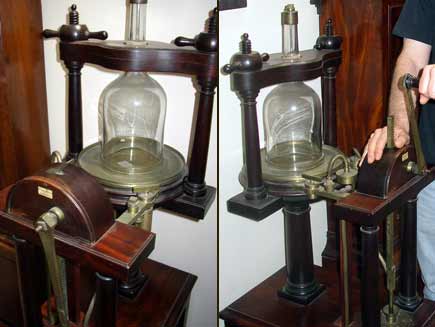
In a few years, some enterprising historian of science is going to write a history of the “culturomics” controversy, and it’s going to be fun to read. In some ways, the episode is a classic model of the social processes underlying the production of knowledge. Whenever someone creates a new method or tool (say, an air pump), and claims to produce knowledge with it, they run head-on into the problem that knowledge is social. If the tool is really new, their experience with it is by definition anomalous, and anomalous experiences — no matter how striking — never count as knowledge. They get dismissed as amusing curiosities.
Robert Boyle's air pump.
The team that published in Science has attempted to address this social problem, as scientists usually do, by making their data public and carefully describing the conditions of their experiment. In this case, however, one runs into the special problem that the underlying texts are the private property of Google, and have been released only in a highly compressed form that strips out metadata. As Matt Jockers may have been the first to note, we don’t yet even have a bibliography of the contents of each corpus. Yesterday, in a new FAQ posted on culturomics.org (see section III.5), researchers acknowledged that they want to release such a bibliography, but haven’t yet received permission from Google to do it.
This is going to produce a very interesting deadlock. I’ve argued in many other posts that the Google dataset is invaluable, because its sheer scale allows us to grasp diachronic patterns that wouldn’t otherwise be visible. But without a list of titles, it’s going to be difficult to cite it as evidence. What I suspect may happen is that humanists will start relying on it in private to discover patterns, but then write those patterns up as if they had just been doing, you know, a bit of browsing in 500,000 books — much as we now use search engines quietly and without acknowledgment, although they in fact entail significant methodological choices. As Benjamin Schmidt has recently been arguing, search technology is based on statistical presuppositions more complex and specific than most people realize, presuppositions that humanists already “use all the time to, essentially, do a form of reading for them.”
A different solution, and the one I’ll try, is to use the Google dataset openly, but in conjunction with other smaller and more transparent collections. I’ll use the scope of the Google dataset to sketch broad contours of change, and then switch to a smaller archive in order to reach firmer and more detailed conclusions. But I still hope that Google can somehow be convinced to release a bibliography — at least of the works that are out of copyright — and I would urge humanists to keep lobbying them.
If some of the dilemmas surrounding this tool are classic history-of-science problems, others are specific to a culture clash between the humanities and the sciences. For instance, I’ve argued in the past that humanists need to develop a quantitative conception of error. We’re very talented at making the perfect the enemy of the good, but that simply isn’t how statistical knowledge works. As the newly-released FAQ points out, there’s a comparably high rate of error in fields like genomics.
On other topics, though, it may be necessary for scientists to learn a bit more about the way humanists think. For instance, one of the corpora included in the ngram viewer is labeled “English fiction.” Matt Jockers was the first to point out that this is potentially ambiguous. I assumed that it contained mostly novels and short stories, since that’s how we use the word in the humanities, but prompted by Matt’s skepticism, I wrote the culturomics team to inquire. Yesterday in the FAQ they answered my question, and it turns out that Matt’s skepticism was well founded.
Crucially, it’s not just actual works of fiction! The English fiction corpus contains some fiction and lots of fiction-associated work, like commentary and criticism. We created the fiction corpus as an experiment meant to explore the notion of creating a subject-specific corpus. We don’t actually use it in the main text of our paper because the experiment isn’t very far along. Even so, a thoughtful data analyst can do interesting things with this corpus, for instance by comparing it to the results for English as a whole.
Humanists are going to find that an eye-opening paragraph. This conception of fiction is radically different from the way we usually understand fiction — as a genre. Instead, the culturomics team has constructed a corpus based on fiction as a subject category; or perhaps it would be better to say that they have combined the two conceptions. I can say pretty confidently that no humanist will want to rely on the corpus of “English fiction” to make claims about fiction; it represents something new and anomalous.
On the other hand, I have to say that I’m personally grateful that the culturomics team made this corpus available — not because it tells me much about fiction, but because it tells me something about what happens when you try to hold “subject designations” constant across time instead of allowing the relative proportions of books in different subjects to fluctuate as they actually did in publishing history. I think they’re right that this is a useful point of comparison, although at the moment the corpus is labeled in a potentially misleading way.
In general, though, I’m going to use the main English corpus, which is easier to interpret. The lack of metadata is still a problem here, but this corpus seems to represent university library collections more fully than any other dataset I have access to. While sheer scale is a crude criterion of representativeness, for some questions it’s the useful one.
The long and short of it all is that the next few years are going to be a wild ride. I’m convinced that advances in digital humanities are reaching the point where they’re going to start allowing us to describe some large, fascinating, and until now largely invisible patterns. But at the moment, the biggest dataset — prominent in public imagination, but also genuinely useful — is curated by scientists, and by a private corporation that has not yet released full information about it. The stage is set for a conflict of considerable intensity and complexity.








 The Stone and the Shell