
Categories
disciplinary history interpretive theory machine learning methodology

Measurement and modeling.

If the Internet is good for anything, it’s good for speeding up the Ent-like conversation between articles, to make that rumble more perceptible by human ears. I thought I might help the process along by summarizing the Stanford Literary Lab’s latest pamphlet — a single-authored piece by Franco Moretti, “‘Operationalizing’: or the function of measurement in modern literary theory.”

One of the many strengths of Moretti’s writing is a willingness to dramatize his own learning process. This pamphlet situates itself as a twist in the ongoing evolution of “computational criticism,” a turn from literary history to literary theory.

Measurement as a challenge to literary theory, one could say, echoing a famous essay by Hans Robert Jauss. This is not what I expected from the encounter of computation and criticism; I assumed, like so many others, that the new approach would change the history, rather than the theory of literature ….

Measurement challenges literary theory because it asks us to “operationalize” existing critical concepts — to say, for instance, exactly how we know that one character occupies more “space” in a work than another. Are we talking simply about the number of words they speak? or perhaps about their degree of interaction with other characters?

Moretti uses Alex Woloch’s concept of “character-space” as a specific example of what it means to operationalize a concept, but he’s more interested in exploring the broader epistemological question of what we gain by operationalizing things. When literary scholars discuss quantification, we often tacitly assume that measurement itself is on trial. We ask ourselves whether measurement is an adequate proxy for our existing critical concepts. Can mere numbers capture the ineffable nuances we assume they possess? Here, Moretti flips that assumption and suggests that measurement may have something to teach us about our concepts — as we’re forced to make them concrete, we may discover that we understood them imperfectly. At the end of the article, he suggests for instance (after begging divine forgiveness) that Hegel may have been wrong about “tragic collision.”

I think Moretti is frankly right about the broad question this pamphlet opens. If we engage quantitative methods seriously, they’re not going to remain confined to empirical observations about the history of predefined critical concepts. Quantification is going to push back against the concepts themselves, and spill over into theoretical debate. I warned y’all back in August that literary theory was “about to get interesting again,” and this is very much what I had in mind.

At this point in a scholarly review, the standard procedure is to point out that a work nevertheless possesses “oversights.” (Insight, meet blindness!) But I don’t think Moretti is actually blind to any of the reflections I add below. We have differences of rhetorical emphasis, which is not the same thing.

For instance, Moretti does acknowledge that trying to operationalize concepts could cause them to dissolve in our hands, if they’re revealed as unstable or badly framed (see his response to Bridgman on pp. 9-10). But he chooses to focus on a case where this doesn’t happen. Hegel’s concept of “tragic collision” holds together, on his account; we just learn something new about it.

In most of the quantitative projects I’m pursuing, this has not been my experience. For instance, in developing statistical models of genre, the first thing I learned was that critics use the word genre to cover a range of different kinds of categories, with different degrees of coherence and historical volatility. Instead of coming up with a single way to operationalize genre, I’m going to end up producing several different mapping strategies that address patterns on different scales.

Something similar might be true even about a concept like “character.” In Vladimir Propp’s Morphology of the Folktale, for instance, characters are reduced to plot functions. Characters don’t have to be people or have agency: when the hero plucks a magic apple from a tree, the tree itself occupies the role of “donor.” On Propp’s account, it would be meaningless to represent a tale like “Le Petit Chaperon Rouge” as a social network. Our desire to imagine narrative as a network of interactions between imagined “people” (wolf ⇌ grandmother) presupposes a separation between nodes and edges that makes no sense for Propp. But this doesn’t necessarily mean that Moretti is wrong to represent Hamlet as a social network: Hamlet is not Red Riding Hood, and tragic drama arguably envisions character in a different way. In short, one of the things we might learn by operationalizing the term “character” is that the term has genuinely different meanings in different genres, obscured for us by the mere continuity of a verbal sign. [I should probably be citing Tzvetan Todorov here, The Poetics of Prose, chapter 5.]

Illustration from "Learning Latent Personas of Film Characters," Bamman et. al.
Illustration from “Learning Latent Personas of Film Characters,” Bamman et. al.
Another place where I’d mark a difference of emphasis from Moretti involves the tension, named in my title, between “measurement” and “modeling.” Moretti acknowledges that there are people (like Graham Sack) who assume that character-space can’t be measured directly, and therefore look for “proxy variables.” But concepts that can’t be directly measured raise a set of issues that are quite a bit more challenging than the concept of a “proxy” might imply. Sack is actually trying to build models that postulate relations between measurements. Digital humanists are probably most familiar with modeling in the guise of topic modeling, a way of mapping discourse by postulating latent variables called “topics” that can’t be directly observed. But modeling is a flexible heuristic that could be used in a lot of different ways.

The illustration on the right is a probabilistic graphical model drawn from a paper on the “Latent Personas of Film Characters” by Bamman, O’Connor, and Smith. The model represents a network of conditional relationships between variables. Some of those variables can be observed (like words in a plot summary w and external information about the film being summarized md), but some have to be inferred, like recurring character types (p) that are hypothesized to structure film narrative.

Having empirically observed the effects of illustrations like this on literary scholars, I can report that they produce deep, Lovecraftian horror. Nothing looks bristlier and more positivist than plate notation.

But I think this is a tragic miscommunication produced by language barriers that both sides need to overcome. The point of model-building is actually to address the reservations and nuances that humanists correctly want to interject whenever the concept of “measurement” comes up. Many concepts can’t be directly measured. In fact, many of our critical concepts are only provisional hypotheses about unseen categories that might (or might not) structure literary discourse. Before we can attempt to operationalize those categories, we need to make underlying assumptions explicit. That’s precisely what a model allows us to do.

It’s probably going to turn out that many things are simply beyond our power to model: ideology and social change, for instance, are very important and not at all easy to model quantitatively. But I think Moretti is absolutely right that literary scholars have a lot to gain by trying to operationalize basic concepts like genre and character. In some cases we may be able to do that by direct measurement; in other cases it may require model-building. In some cases we may come away from the enterprise with a better definition of existing concepts; in other cases those concepts may dissolve in our hands, revealed as more unstable than even poststructuralists imagined. The only thing I would say confidently about this project is that it promises to be interesting.
Categories
disciplinary history interpretive theory machine learning

Interesting times for literary theory.

A couple of weeks ago, after reading abstracts from DH2013, I said that the take-away for me was that “literary theory is about to get interesting again” – subtweeting the course of history in a way that I guess I ought to explain.

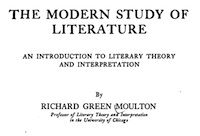
A 1915 book by Chicago's "Professor of Literary Theory."
A 1915 book by Chicago’s “Professor of Literary Theory.”

In the twentieth century, “literary theory” was often a name for the sparks that flew when literary scholars pushed back against challenges from social science. Theory became part of the academic study of literature around 1900, when the comparative study of folklore seemed to reveal coherent patterns in national literatures that scholars had previously treated separately. Schools like the University of Chicago hired “Professors of Literary Theory” to explore the controversial possibility of generalization.* Later in the century, structural linguistics posed an analogous challenge, claiming to glimpse an organizing pattern in language that literary scholars sought to appropriate and/or deconstruct. Once again, sparks flew.

I think literary scholars are about to face a similarly productive challenge from the discipline of machine learning — a subfield of computer science that studies learning as a problem of generalization from limited evidence. The discipline has made practical contributions to commercial IT, but it’s an epistemological method founded on statistics more than it is a collection of specific tools, and it tends to be intellectually adventurous: lately, researchers are trying to model concepts like “character” (pdf) and “gender,” citing Judith Butler in the process (pdf).

At DH2013 and elsewhere, I see promising signs that literary scholars are gearing up to reply. In some cases we’re applying methods of machine learning to new problems; in some cases we’re borrowing the discipline’s broader underlying concepts (e.g. the notion of a “generative model”); in some cases we’re grappling skeptically with its premises. (There are also, of course, significant collaborations between scholars in both fields.)

This could be the beginning of a beautiful friendship. I realize a marriage between machine learning and literary theory sounds implausible: people who enjoy one of these things are pretty likely to believe the other is fraudulent and evil.** But after reading through a couple of ML textbooks,*** I’m convinced that literary theorists and computer scientists wrestle with similar problems, in ways that are at least loosely congruent. Neither field is interested in the mere accumulation of data; both are interested in understanding the way we think and the kinds of patterns we recognize in language. Both fields are interested in problems that lack a single correct answer, and have to be mapped in shades of gray (ML calls these shades “probability”). Both disciplines are preoccupied with the danger of overgeneralization (literary theorists call this “essentialism”; computer scientists call it “overfitting”). Instead of saying “every interpretation is based on some previous assumption,” computer scientists say “every model depends on some prior probability,” but there’s really a similar kind of self-scrutiny involved.

It’s already clear that machine learning algorithms (like topic modeling) can be useful tools for humanists. But I think I glimpse an even more productive conversation taking shape, where instead of borrowing fully-formed “tools,” humanists borrow the statistical language of ML to think rigorously about different kinds of uncertainty, and return the favor by exposing the discipline to boundary cases that challenge its methods.

Won’t quantitative models of phenomena like plot and genre simplify literature by flattening out individual variation? Sure. But the same thing could be said about Freud and Lévi-Strauss. When scientists (or social scientists) write about literature they tend to produce models that literary scholars find overly general. Which doesn’t prevent those models from advancing theoretical reflection on literature! I think humanists, conversely, can warn scientists away from blind alleys by reminding them that concepts like “gender” and “genre” are historically unstable. If you assume words like that have a single meaning, you’re already overfitting your model.

Of course, if literary theory and computer science do have a conversation, a large part of the conversation is going to be a meta-debate about what the conversation can or can’t achieve. And perhaps, in the end, there will be limits to the congruence of these disciplines. Alan Liu’s recent essay in PMLA pushes against the notion that learning algorithms can be analogous to human interpretation, suggesting that statistical models become meaningful only through the inclusion of human “seed concepts.” I’m not certain how deep this particular disagreement goes, because I think machine learning researchers would actually agree with Liu that statistical modeling never starts from a tabula rasa. Even “unsupervised” algorithms have priors. More importantly, human beings have to decide what kind of model is appropriate for a given problem: machine learning aims to extend our leverage over large volumes of data, not to take us out of the hermeneutic circle altogether.

But as Liu’s essay demonstrates, this is going to be a lively, deeply theorized conversation even where it turns out that literary theory and computer science have fundamental differences. These disciplines are clearly thinking about similar questions: Liu is right to recognize that unsupervised learning, for instance, raises hermeneutic questions of a kind that are familiar to literary theorists. If our disciplines really approach similar questions in incompatible ways, it will be a matter of some importance to understand why.

0804784469* <plug> For more on “literary theory” in the early twentieth century, see the fourth chapter of Why Literary Periods Mattered: Historical Contrast and the Prestige of English Studies (2013, hot off the press). The book has a lovely cover, but unfortunately has nothing to do with machine learning. </plug>

** This post grows out of a conversation I had with Eleanor Courtemanche, in which I tried to convince her that machine learning doesn’t just reproduce the biases you bring to it.

*** Practically, I usually rely on Data Mining: Practical Machine Learning Tools and Techniques (Ian Witten, Eibe Frank, Mark Hall), but to understand the deeper logic of the field I’ve been reading Machine Learning: A Probabilistic Perspective (Kevin P. Murphy). Literary theorists may appreciate Murphy’s remark that wealth has a long-tailed distribution, “especially in plutocracies such as the USA” (43).

PS later that afternoon: Belatedly realize I didn’t say anything about the most controversial word in my original tweet: “literary theory is about to get interesting again.” I suppose I tacitly distinguish literary theory (which has been a little sleepy lately, imo) from theory-sans-adjective (which has been vigorous, although hard to define). But now I’m getting into a distinction that’s much too slippery for a short blog post.