Digital collections are vastly expanding literary scholars’ field of view: instead of describing a few hundred well-known novels, we can now test our claims against corpora that include tens of thousands of works. But because this expansion of scope has also raised expectations, the question of representativeness is often discussed as if it were a weakness rather than a strength of digital methods. How can we ever produce a corpus complete and balanced enough to represent print culture accurately?
I think the question is wrongly posed, and I’d like to suggest an alternate frame. As I see it, the advantage of digital methods is that we never need to decide on a single model of representation. We can and should keep enlarging digital collections, to make them as inclusive as possible. But no matter how large our collections become, the logic of representation itself will always remain open to debate. For instance, men published more books than women in the eighteenth century. Would a corpus be correctly balanced if it reproduced those disproportions? Or would a better model of representation try to capture the demographic reality that there were roughly as many women as men? There’s something to be said for both views.
To take another example, Scott Weingart has pointed out that there’s a basic tension in text mining between measuring “what was written” and “what was read.” A corpus that contains one record for every title, dated to its year of first publication, would tend to emphasize “what was written.” Measuring “what was read” is harder: a perfect solution would require sales figures, reviews, and other kinds of evidence. But, as a quick stab at the problem, we could certainly measure “what was printed,” by including one record for every volume in a consortium of libraries like HathiTrust. If we do that, a frequently-reprinted work like Robinson Crusoe will carry about a hundred times more weight than a novel printed only once.
We’ll never create a single collection that perfectly balances all these considerations. But fortunately, we don’t need to: there’s nothing to prevent us from framing our inquiry instead as a comparative exploration of many different corpora balanced in different ways.
For instance, if we’re troubled by the difference between “what was written” and “what was read,” we can simply create two different collections — one limited to first editions, the other including reprints and duplicate copies. Neither collection is going to be a perfect mirror of print culture. Counting the volumes of a novel preserved in libraries is not the same thing as counting the number of its readers. But comparing these collections should nevertheless tell us whether the issue of popularity makes much difference for a given research question.
I suspect in many cases we’ll find that it makes little difference. For instance, in tracing the development of literary language, I got interested in the relative prominence of words that entered English before and after the Norman Conquest — and more specifically, in how that ratio changed over time in different genres. My first approach to this problem was based on a collection of 4,275 volumes that were, for the most part, limited to first editions (773 of these were prose fiction).
But I recognized that other scholars would have questions about the representativeness of my sample. So I spent the last year wrestling with 470,000 volumes from HathiTrust; correcting their OCR and using classification algorithms to separate fiction from the rest of the collection. This produced a collection with a fundamentally different structure — where a popular work of fiction could be represented by dozens or scores of reprints scattered across the timeline. What difference did that make to the result? (click through to enlarge) The same question posed to two different collections. 773 hand-selected first editions on the left; on the right, 47,549 volumes, including many translations and reprints. Yearly ratios are plotted rather than individual works.
It made almost no difference. The scatterplots look different, of course, because the hand-selected collection (on the left) is relatively stable in size across the timespan, and has a consistent kind of noisiness, whereas the HathiTrust collection (on the right) gets so huge in the nineteenth century that noise almost disappears. But the trend lines are broadly comparable, although the collections were created in completely different ways and rely on incompatible theories of representation.
I don’t regret the year I spent getting a binocular perspective on this question. Although in this case changing the corpus made little difference to the result, I’m sure there are other questions where it will make a difference. And we’ll want to consider as many different models of representation as we can. I’ve been gathering metadata about gender, for instance, so that I can ask what difference gender makes to a given question; I’d also like to have metadata about the ethnicity and national origin of authors.
But the broader point I want to make here is that people pursuing digital research don’t need to agree on a theory of representation in order to cooperate.
If you’re designing a shared syllabus or co-editing an anthology, I suppose you do need to agree in advance about the kind of representativeness you’re aiming to produce. Space is limited; tradeoffs have to be made; you can only select one set of works.
But in digital research, there’s no reason why we should ever have to make up our minds about a model of representativeness, let alone reach consensus. The number of works we can select for discussion is not limited. So we don’t need to imagine that we’re seeking a correspondence between the reality of the past and any set of works. Instead, we can look at the past from many different angles and ask how it’s transformed by different perspectives. We can look at all the digitized volumes we have — and then at a subset of works that were widely reprinted — and then at another subset of works published in India — and then at three or four works selected as case studies for close reading. These different approaches will produce different pictures of the past, to be sure. But nothing compels us to make a final choice among them.
Of all our literary-historical narratives it is the history of criticism itself that seems most wedded to a stodgy history-of-ideas approach—narrating change through a succession of stars or contending schools. While scholars like John Guillory and Gerald Graff have produced subtler models of disciplinary history, we could still do more to complicate the narratives that organize our discipline’s understanding of itself.
A browsable network based on Underwood's model of PMLA. Click through, then mouse over or click on individual topics.The archive of scholarship is also, unlike many twentieth-century archives, digitized and available for “distant reading.” Much of what we need is available through JSTOR’s Data for Research API. So last summer it occurred to a group of us that topic modeling PMLA might provide a new perspective on the history of literary studies. Although Goldstone and Underwood are writing this post, the impetus for the project also came from Natalia Cecire, Brian Croxall, and Roger Whitson, who may do deeper dives into specific aspects of this archive in the near future.
Topic modeling is a technique that automatically identifies groups of words that tend to occur together in a large collection of documents. It was developed about a decade ago by David Blei among others. Underwood has a blog post explaining topic modeling, and you can find a practical introduction to the technique at the Programming Historian. Jonathan Goodwin has explained how it can be applied to the word-frequency data you get from JSTOR.
Obviously, PMLA is not an adequate synecdoche for literary studies. But, as a generalist journal with a long history, it makes a useful test case to assess the value of topic modeling for a history of the discipline.
Goldstone and Underwood each independently produced several different models of PMLA, using different software, stopword lists, and numbers of topics. Our results overlapped in places and diverged in places. But we’ve reached a shared sense that topic modeling can enrich the history of literary scholarship by revealing trends that are presently invisible.
What is a topic?
A “topic model” assigns every word in every document to one of a given number of topics. Every document is modeled as a mixture of topics in different proportions. A topic, in turn, is a distribution of words—a model of how likely given words are to co-occur in a document. The algorithm (called LDA) knows nothing “meta” about the articles (when they were published, say), and it knows nothing about the order of words in a given document.
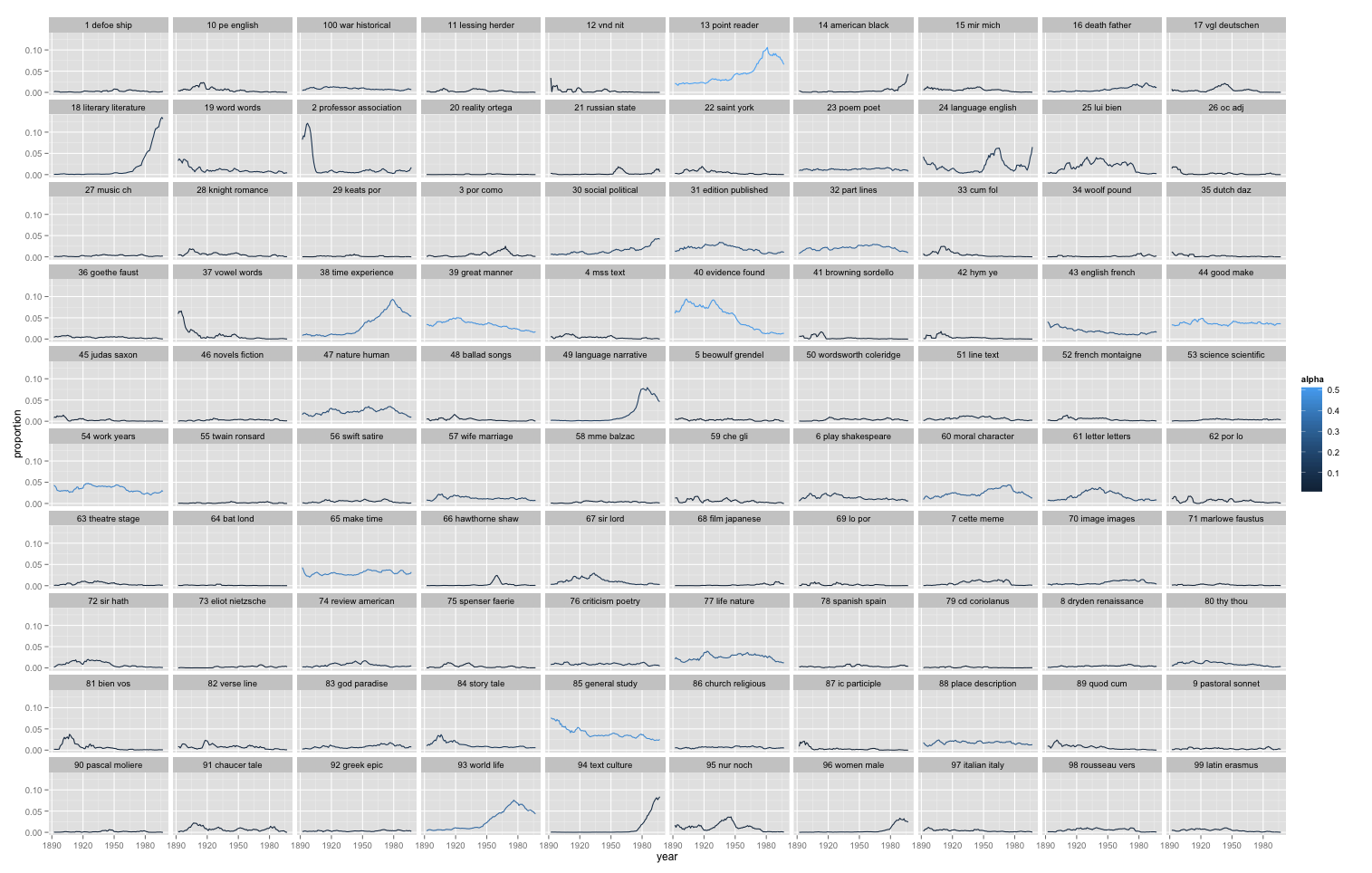
This is a picture of 5940 articles from PMLA, showing the changing presence of each of 100 "topics" in PMLA over time. (Click through to enlarge; a longer list of topic keywords is here.) For example, the most probable words in the topic arbitrarily numbered 59 in the model visualized above are, in descending order:
che gli piu nel lo suo sua sono io delle perche questo quando ogni mio quella loro cosi dei
This is not a “topic” in the sense of a theme or a rhetorical convention. What these words have in common is simply that they’re basic Italian words, which appear together whenever an extended Italian text occurs. And this is the point: a “topic” is neither more nor less than a pattern of co-occurring words.
Nonetheless, a topic like topic 59 does tell us about the history of PMLA. The articles where this topic achieved its highest proportion were:
Antonio Illiano, “Momenti e problemi di critica pirandelliana: L’umorismo, Pirandello e Croce, Pirandello e Tilgher,” PMLA 83 no. 1 (1968): pp. 135-143
Domenico Vittorini, “I Dialogi ad Petrum Histrum di Leonardo Bruni Aretino (Per la Storia del Gusto Nell’Italia del Secolo XV),” PMLA 55 no. 3 (1940): pp. 714-720
Vincent Luciani, “Il Guicciardini E La Spagna,” PMLA 56 no. 4 (1941): pp. 992-1006
And here’s a plot of the changing proportions of this topic over time, showing moving 1-year and 5-year averages:
We see something about PMLA that is worth remembering for the history of criticism, namely, that it has embedded Italian less and less frequently in its language since midcentury. (The model shows that the same thing is true of French and German.)
What can topics tell us about the history of theory?
Of course a topic can also be a subject category—modeling PMLA, we have found topics that are primarily “about Beowulf” or “about music.” Or a topic can be a group of words that tend to co-occur because they’re associated with a particular critical approach.
Here, for instance, we have a topic from Underwood’s 150-topic model associated with discussions of pattern and structure in literature. We can characterize it by listing words that occur more commonly in the topic than elsewhere, or by graphing the frequency of the topic over time, or by listing a few articles where it’s especially salient.
At first glance this topic might seem to fit neatly into a familiar story about critical history. We know that there was a mid-twentieth-century critical movement called “structuralism,” and the prominence of “structure” here might suggest that we’re looking at the rise and fall of that movement. In part, perhaps, we are. But the articles where this topic is most prominent are not specifically “structuralist.” In the top four articles, Ferdinand de Saussure, Claude Lévi-Strauss, and Northrop Frye are nowhere in evidence. Instead these articles appeal to general notions of symmetry, or connect literary patterns to Neoplatonism and Renaissance numerology.
By forcing us to attend to concrete linguistic practice, topic modeling gives us a chance to bracket our received assumptions about the connections between concepts. While there is a distinct mid-century vogue for structure, it does not seem strongly associated with the concepts that are supposed to have motivated it (myth, kinship, language, archetype). And it begins in the 1940s, a decade or more before “structuralism” is supposed to have become widespread in literary studies. We might be tempted to characterize the earlier part of this trend as “New Critical interest in formal unity” and the latter part of it as “structuralism.” But the dividing line between those rationales for emphasizing pattern is not evident in critical vocabulary (at least not at this scale of analysis).
This evidence doesn’t necessarily disprove theses about the history of structuralism. Topic modeling might not reveal varying “rationales” for using a word even if those rationales did vary. The strictly linguistic character of this technique is a limitation as well as a strength: it’s not designed to reveal motivation or conflict. But since our histories of criticism are already very intellectual and agonistic, foregrounding the conscious beliefs of contending critical “schools,” topic modeling may offer a useful corrective. This technique can reveal shifts of emphasis that are more gradual and less conscious than the ones we tend to celebrate.
It may even reveal shifts of emphasis of which we were entirely unaware. “Structure” is a familiar critical theme, but what are we to make of this?
A fuller list of terms included in this topic would include “character”, “fact,” “choice,” “effect,” and “conflict.” Reading some of the articles where the topic is prominent, it appears that in this topic “point” is rarely the sort of point one makes in an argument. Instead it’s a moment in a literary work (e.g., “at the point where the rain occurs,” in Robert apRoberts 379). Apparently, critics in the 1960s developed a habit of describing literature in terms of problems, questions, and significant moments of action or choice; the habit intensified through the early 1980s and then declined. This habit may not have a name; it may not line up neatly with any recognizable school of thought. But it’s a fact about critical history worth knowing.
Note that this concern with problem-situations is embodied in common words like “way” and “cannot” as well as more legible, abstract terms. Since common words are often difficult to interpret, it can be tempting to exclude them from the modeling process. It’s true that a word like “the” isn’t likely to reveal much. But subtle, interesting rhetorical habits can be encoded in common words. (E.g. “itself” is especially common in late-20c theoretical topics.)
We don’t imagine that this brief blog post has significantly contributed to the history of criticism. But we do want to suggest that topic modeling could be a useful resource for that project. It has the potential to reveal shifts in critical vocabulary that aren’t well described, and that don’t fit our received assumptions about the history of the discipline.
Why browse topics as a network?
The fact that a word is prominent in topic A doesn’t prevent it from also being prominent in topic B. So certain generalizations we might make about an individual topic (for instance, that Italian words decline in frequency after midcentury) will be true only if there’s not some other “Italian” topic out there, picking up where the first one left off.
For that reason, interpreters really need to survey a topic model as a whole, instead of considering single topics in isolation. But how can you browse a whole topic model? We’ve chosen relatively small numbers of topics, but it would not be unreasonable to divide literary scholarship into, say, 500 topics. Information overload becomes a problem.
A browsable image map of 150 topics from PMLA. After you click through you can mouseover (or click) individual topics for more information.We’ve found network graphs useful here. Click on the image of the network on the right to browse Underwood’s 150-topic model. The size of each node (roughly) indicates the number of words in the topic; color indicates the average date of words. (Blue topics are older; yellow topics are more recent.) Topics are linked to each other if they tend to appear in the same articles. Topics have been labeled with their most salient word—unless that word was already taken for another topic, or seemed misleading. Mousing over a topic reveals a list of words associated with it; with most topics it’s also possible to click through for more information.
The structure of the network makes a loose kind of sense. Topics in French and German form separate networks floating free of the main English structure. Recent topics tend to cluster at the bottom of the page. And at the bottom, historical and pedagogical topics tend to be on the left, while formal, phenomenological, and aesthetic categories tend to be on the right.
But while it’s a little eerie to see patterns like this emerge automatically, we don’t advise readers to take the network structure too seriously. A topic model isn’t a network, and mapping one onto a network can be misleading. For instance, topics that are physically distant from each other in this visualization are not necessarily unrelated. Connections below a certain threshold go unrepresented.
Goldstone’s 100-topic model of PMLA; click through to enlarge.Moreover, as you can see by comparing illustrations in this post, a little fiddling with dials can turn the same data into networks with rather different shapes. It’s probably best to view network visualization as a convenience. It may help readers browse a model by loosely organizing topics—but there can be other equally valid ways to organize the same material.
How did our models differ?
The two models we’ve examined so far in this post differ in several ways at once. They’re based on different spans of PMLA‘s print run (1890–1999 and 1924–2006). They were produced with different software. Perhaps most importantly, we chose different numbers of topics (100 and 150).
But the models we’re presenting are only samples. Goldstone and Underwood each produced several models of PMLA, changing one variable at a time, and we have made some closer apples-to-apples comparisons.
Broadly, the conclusion we’ve reached is that there’s both a great deal of fluidity and a great deal of consistency in this process. The algorithm has to estimate parameters that are impossible to calculate exactly. So the results you get will be slightly different every time. If you run the algorithm on the same corpus with the same number of topics, the changes tend to be fairly minor. But if you change the number of topics, you can get results that look substantially different.
On the other hand, to say that two models “look substantially different” isn’t to say that they’re incompatible. A jigsaw puzzle cut into 100 pieces looks different from one with 150 pieces. If you examine them piece by piece, no two pieces are the same—but once you put them together you’re looking at the same picture. In practice, there was a lot of overlap between our models; on the older end of the spectrum you often see a topic like “evidence fact,” while the newer end includes topics that foreground narrative, rhetoric, and gender. Some of the more surprising details turned out to be consistent as well. For instance, you might expect the topic “literary literature” to skew toward the older end of the print run. But in fact this is a relatively recent topic in both of our models, associated with discussion of canonicity. (Perhaps the owl of Minerva flies only at dusk?)
Contrasting models: a short example
While some topics look roughly the same in all of our models, it’s not always possible to identify close correlates of that sort. As you vary the overall number of topics, some topics seem to simply disappear. Where do they go? For example, there is no exact counterpart in Goldstone’s model to that “structure” topic in Underwood’s model. Does that mean it is a figment? Underwood isolated the following article as the most prominent exemplar:
Robert E. Burkhart, The Structure of Wuthering Heights, Letter to the Editor, PMLA 87 no. 1 (1972): 104–5. (Incidentally, jstor has miscategorized this as a “full-length article.”)
Goldstone’s model puts more than half of Burkhart’s comment in three topics:
0.24 topic 38 time experience reality work sense form present point world human process structure concept individual reader meaning order real relationship
0.13 topic 46 novels fiction poe gothic cooper characters richardson romance narrator story novelist reader plot novelists character reade hero heroine drf
0.12 topic 13 point reader question interpretation meaning make reading view sense argument words word problem makes evidence read clear text readers
The other prominent documents in Underwood’s 109 are connected to similar topics in Goldstone’s model. The keywords for Goldstone’s topic 38, the top topic here, immediately suggest an affinity with Underwood’s topic 109. Now compare the time course of Goldstone’s 38 with Underwood’s 109 (the latter is above):
It is reasonable to infer that some portion of the words in Underwood’s “structure” topic are absorbed in Goldstone’s “time experience” topic. But “time experience reality work sense” looks less like vocabulary for describing form (although “form” and “structure” are included in it, further down the list; cf. the top words for all 100 topics), and more like vocabulary for talking about experience in generalized ways—as is also suggested by the titles of some articles in which that topic is substantially present:
“The Vanishing Subject: Empirical Psychology and the Modern Novel”
“Metacommentary”
“Toward a Modern Humanism”
“Wordsworth’s Inscrutable Workmanship and the Emblems of Reality”
This version of the topic is no less “right” or “wrong” than the one in Underwood’s model. They both reveal the same underlying evidence of word use, segmented in different but overlapping ways. Instead of focusing our vision on affinities between “form” and “structure”, Goldstone’s 100-topic model shows a broader connection between the critical vocabulary of form and structure and the keywords of “humanistic” reflection on experience.
The most striking contrast to these postwar themes is provided by a topic which dominates in the prewar period, then gives way before “time experience” takes hold. Here are box plots by ten-year intervals of the proportions of another topic, Goldstone’s topic 40, in PMLA articles:
Underwood’s model shows a similar cluster of topics centering on questions of evidence and textual documentation, which similarly decrease in frequency. The language of PMLA has shown a consistently declining interest in “evidence found fact” in the era of the postwar research university.
So any given topic model of a corpus is not definitive. Each variation in the modeling parameters can produce a new model. But although topic models vary, models of the same corpus remain fundamentally consistent with each other.
Using LDA as evidence
It’s true that a “topic model” is simply a model of how often words occur together in a corpus. But information of that kind has a deeper significance than we might at first assume. A topic model doesn’t just show you what people are writing about (a list of “topics” in our ordinary sense of the word). It can also show you how they’re writing. And that “how” seems to us a strong clue to social affinities—perhaps especially for scholars, who often identify with a methodology or critical vocabulary. To put this another way, topic modeling can identify discourses as well as subject categories and embedded languages. Naturally we also need other kinds of evidence to produce a history of the discipline, including social and institutional evidence that may not be fully manifest in discourse. But the evidence of topic modeling should be taken seriously.
As you change the number of topics (and other parameters), models provide different pictures of the same underlying collection. But this doesn’t mean that topic modeling is an indeterminate process, unreliable as evidence. All of those pictures will be valid. They are taken (so to speak) at different distances, and with different levels of granularity. But they’re all pictures of the same evidence and are by definition compatible. Different models may support different interpretations of the evidence, but not interpretations that absolutely conflict. Instead the multiplicity of models presents us with a familiar choice between “lumping” or “splitting” cultural phenomena—a choice where we have long known that multiple levels of analysis can coexist. This multiplicity of perspective should be understood as a strength rather than a limitation of the technique; it is part of the reason why an analysis using topic modeling can afford a richly detailed picture of an archive like PMLA.
Appendix: How did we actually do this?
The PMLA data obtained from JSTOR was independently processed by Goldstone and Underwood for their different LDA tools. This created some quantitative subtleties that we’ve saved for this appendix to keep this post accessible to a broad audience. If you read closely, you’ll notice that we sometimes talk about the “probability” of a term in a topic, and sometimes about its “salience.” Goldstone used MALLET for topic modeling, whereas Underwood used his own Java implementation of LDA. As a result, we also used slightly different formulas for ranking words within a topic. MALLET reports the raw probability of terms in each topic, whereas Underwood’s code uses a slightly more complex formula for term salience drawn from Blei & Lafferty (2009). In practice, this did not make a huge difference.
MALLET also has a “hyperparameter optimization” option which Goldstone’s 100-topic model above made use of. Before you run screaming, “hyperparameters” are just dials that control how much fuzziness is allowed in a topic’s distribution across words (beta) or across documents (alpha). Allowing alpha to vary allows greater differentiation between the sizes of large topics (often with common words), and smaller (often more specialized) topics. (See “Why Priors Matter,” Wallach, Mimno, and McCallum, 2009.) In any event, Goldstone’s 100-topic model used hyperparameter optimization; Underwood’s 150-topic model did not. A comparison with several other models suggests that the difference between symmetric and asymmetric (optimized) alpha parameters explains much of the difference between their structures when visualized as networks.
Goldstone’s processing scripts are online in a github repository. The same repository includes R code for making the plots from Goldstone’s model. Goldstone would also like to thank Bob Gerdes of Rutgers’s Office of Instructional and Research Technology for support for running mallet on the university’s apps.rutgers.edu server, Ben Schmidt for helpful comments at a THATCamp Theory session, and Jon Goodwin for discussion and his excellent blog posts on topic-modeling jstor data.
Force-directed graphs are tricky. At their best, the perspective they offer can be very helpful; data points cluster into formations that feel intuitive and look approachable. At their worst, though, they can be too cluttered, and the algorithms that make everything fall into place can deceive as much as they clarify.
But there’s still a good chance that, despite the problems that come along with making a network model of anything (and the problems introduced by making network models of texts), they can still be helpful for interpreting topic models. Visualizations aren’t exactly analysis, so what I share below is meant to raise more questions than answers. We also tried to represent as many aspects of the data as possible without breaking (or breaking only a little) the readability of the visualizations. There were some very unsuccessful tries before we arrived at what is below.
A Few Remarks on Method
As part of our work together, Ted has run some topic models on his 19th century literature dataset and computed the correlation of each topic to other topics. We decided to try this out to see topic distribution among genres, and to get a feel for how topics clustered with one another. Which documents belong to what topic aren’t important for now, although in time I’d like to have the nodes link to the text of the documents. Ted has also calculated the predominant genre to which each topic belongs. And, after building a network model where topic correlation equals edge value, I’ve run the Girvan-Newman algorithm to assess how the topics would cluster by their associations with other topics (I like this approach to grouping better than others for examinations of overall graph structure like this one, as we’re not as interested in individual cliques or clusters). What we get then, is two different ways to categorize the topic: on the one hand we have the genre the topic appears in most (with the genres being assigned to individual documents by a human expert), and on the other we see groupings based on co-occurence with other topics.
The visualizations shown here are all built using d3.js, the excellent open source javascript library created by Mike Bostock. Each of the graphs are force-directed: all nodes possess a negative charge and repel from one another. All links bond to these nodes and hold them together. Many force-directed models set their links to behave like springs and contract to the shortest possible distance between nodes, but these graphs below don’t exactly use Hooke’s law to calculate bond length. Instead, they aim for a specific bond length (in this case, 20 pixels) and draw a link as close as possible to that length given the charges acting on it.
I wanted physical proximity of nodes to one another to means something, so the graphs below have variable bond strengths, which means that depending on the value of the bond (which in these graphs is a function of the correlation of a topic with the topic to which it is linked), it will resist or cooperate with being “stretched” (or really, drawn at a longer distance as other stronger bonds take precedence in being drawn closer to the ideal length of 20px). This has implications for how to interpret distance between nodes in these images. The X and Y axes have no set value, so distance does not equal correlation. This is more of a Newtonian than Euclidean space, which means that a short link can indicate a strong bond between nodes, but strong bonds can also be stretched by opposing forces (like other bonds) exerted on nodes at either end of the bond. So distance between nodes can be significant, but only once considered in context of the whole model and its constitutive metaphor of a physical system. Click on the image below for a sample of what we’re talking about:
D3 allows this is to be an interactive visual, and mousing over an individual node will reveal the first ten words of the topic it represents. Also, clicking on a node allows for pulling and rearranging the graph. Doing this a few times helps reinforce the idea that distance between nodes is the result of a set of simulated physical properties. The colors assigned to the Newman groups are arbitrary, but there’s a key on the left to help distinguish among similar colors.
Comparing Two Graphs
Network graphs are more useful when you can compare them to other network graphs. We split the dataset into two halves, and Ted generated 100 topics for each half of the century. We used slightly different genre labels, but we calculated Newman groups again to produce the two graphs below (again, click through to interact with the graph):
Like the first graph, Newman color assignments are arbitrary; what’s purple in the first 50 years of topics has nothing to do with what’s purple in the next 50 years of topics. I’ve modified these graphs in two key ways to help with reading them. Firstly, bond thickness now variable, and it is a function of bond strength (bond strength derived from correlation). This helps assess if a bond is longer because it’s being stretched or because it’s weak, or both. Secondly, I’ve added node “halos” to emphasize the degree to which the nodes cluster, as well as highlight the Newman groups.
Here’s an alternative graph that colors the nodes by genre instead of Newman group, leaving only the halo to represent group affiliation:
I won’t pretend that any of these are easy to read immediately, but one of our experiments in this was to try to represent as many dimensions as possible to create an exploratory framework for a topic model. Halo and node diameter are set, but the two elements on the visualization are independent and could represent topic size, degree of genre predominance in a topic, etc.
My hope is that these visualizations can be insightful and might help us work through the benefits and disadvantages of force-directed layouts for visualizing topic models.
As for interpretation and analysis, here is the part where I punt to domain experts in 19th century literature and history…
I’ve been collaborating with Michael Simeone of I-CHASS on strategies for visualizing topic models. Michael is using d3.js to build interactive visualizations that are much nicer than what I show below, but since this problem is probably too big for one blog post I thought I might give a quick preview.
Basically the problem is this: How do you visualize a whole topic model? It’s easy to pull out a single topic and visualize it — as a word cloud, or as a frequency distribution over time. But it’s also risky to focus on a single topic, because in LDA, the boundaries between topics are ontologically sketchy.
After all, LDA will create as many topics as you ask it to. If you reduce that number, topics that were separate have to fuse; if you increase it, topics have to undergo fission. So it can be misleading to make a fuss about the fact that two discourses are or aren’t “included in the same topic.” (Ben Schmidt has blogged a nice example showing where this goes astray.) Instead we need to ask whether discourses are relatively near each other in the larger model.
But visualizing the larger model is tricky. The go-to strategy for something like this in digital humanities is usually a network graph. I have some questions about that strategy, but since examples are more fun than abstract skepticism, I should start by providing an illustration. The underlying topic model here was produced by LDA on the top 10k words in 872 volume-length documents. Then I produced a correlation matrix of topics against topics. Finally I created a network in Gephi by connecting topics that correlated strongly with each other (see the notes at the end for the exact algorithm). Topics were labeled with their single most salient word, except in three cases where I changed the label manually. The size of each node is roughly log-proportional to the number of tokens in the topic; nodes are colored to reflect the genre most prominent in each topic. (Since every genre is actually represented in every topic, this is only a rough and relative characterization.) Click through for a larger version.
Since single-word labels are usually misleading, a graph like this would be more useful if you could mouseover a topic and get more information. E.g., the topic labeled “cases” (connecting the dark cluster at top to the rest of the graph) is actually “cases death dream case heard saw mother room time night impression.” (Added Nov 20: If you click through, I’ve now edited the underlying illustration as an image map so you get that information when you mouseover individual topics.)
A network graph does usefully dramatize several important things about the model. It reveals, for instance, that “literary” topics tend to be more strongly connected with each other than nonfiction topics (probably because topics dominated by nonfiction also tend to have a relatively specialized vocabulary).
On the other hand, I think a graph like this could easily be over-interpreted. Graphs are good models for structures that are really networks: i.e., structures with discrete nodes that may or may not be related to each other. But a topic model is not really a network. For one thing, as I was pointing out above, the boundaries between topics are at bottom arbitrary, so these nodes aren’t in reality very discrete. Also, in reality every topic is connected to every other. But as Scott Weingart has been pointing out, you usually have to cut edges to produce a network, and this means that you’re always losing some of the data. Every correlation below some threshold of significance will be lost.
That’s a nontrivial loss, because it’s not safe to assume that negative correlations between topics don’t matter. If two topics absolutely never occur together, that’s a meaningful relation! For instance, if language about the slave trade absolutely never occurred in books of poetry, that would tell us something about both discourses.
So I think we’ll also want to consider visualizing topic models through a strategy like PCA (Principal Component Analysis). Instead of simplifying the model by cutting selected edges, PCA basically “compresses” the whole model into two dimensions. That way you can include all of the data (even the evidence provided by negative correlations). When I perform PCA on the same 1850-99 model, I get this illustration. I’m afraid it’s difficult to read unless you click through and click again to magnify:
I think that’s a more accurate visualization of the relationship between topics, both because it rests on a sounder basis mathematically, and because I observe that in practice it does a good job of discriminating genres. But it’s not as fun as a network visually. Also, since specialized discourses are hard to differentiate in only two dimensions, specialized scientific topics (“temperature,” “anterior”) tend to clump in an unreadable electron cloud. But I’m hoping that Michael and I can find some technical fixes for that problem.
Technical notes: To turn a topic model into a correlation matrix, I simply use Pearson correlation to compare topic distributions over documents. I’ve tried other strategies: comparing distributions over the lexicon, for instance, or using cosine similarity instead of correlation.
The network illustration above was produced with Gephi. I selected edges with an ad-hoc algorithm: 1) take the strongest correlation for each topic 2) if the second-strongest correlation is stronger than .2, include that one too. 3) include additional edges if the correlation is stronger than .38. This algorithm is mathematically indefensible, but it produces pretty topic maps.
I find that it works best to perform PCA on the correlation matrix rather than the underlying word counts. Maybe in the future I’ll be able to explain why, but for now I’ll simply commend these lines of R code to readers who want to try it at home:
pca <- princomp(correlationmatrix)
x <- predict(pca)[,1]
y <- predict(pca)[,2]
This post is an outline of discussion topics I’m proposing for a workshop at NASSR2012 (a conference of Romanticists). I’m putting it on the blog since some of the links might be useful for a broader audience.
In the morning I’ll give a few examples of concrete literary results produced by text mining. I’ll start the afternoon workshop by opening two questions for discussion: first, what are the obstacles confronting a literary scholar who might want to experiment with quantitative methods? Second, how do those methods actually work, and what are their limits?
I’ll also invite participants to play around with a collection of 818 works between 1780 and 1859, using an R program I’ve provided for the occasion. Links for these materials are at the end of this post.
I. HOW DIFFICULT IS IT TO GET STARTED?
There are two kinds of obstacles: getting the data you need, and getting the digital skills you need.
1. Is it really necessary to have a large collection of texts?
This is up for debate. But I tend to think the answer is “yes.”
Not because bigger is better, or because “distant reading” is the new hotness. It’s still true that a single passage, perceptively interpreted, may tell us more than a thousand volumes.
But if you want to interpret a single passage, you fortunately already have a wrinkled protein sponge that will do a better job than any computer. Quantitative analysis starts to make things easier only when we start working on a scale where it’s impossible for a human reader to hold everything in memory. Your mileage may vary, but I’d say, more than ten books?
And actually, you need a larger collection than that, because quantitative analysis tends to require context before it becomes meaningful. It doesn’t mean much to say that the word “motion” is common in Wordsworth, for instance, until we know whether “motion” is more common in his works than in other nineteenth-century poets. So yes, text-mining can provide clues that lead to real insights about a single author or text. But it’s likely that you’ll need a collection of several hundred volumes, for comparison, before those clues become legible.
Words that are consistently more common in works by William Wordsworth than in other poets from 1780 to 1850. I’ve used Wordle’s graphics, but the words have been selected by a Mann-Whitney test, which measures overrepresentation relative to a context — not by Wordle’s own (context-free) method. See the R script at the end of this post.
This isn’t to deny that there are interesting things that can be done digitally with a single text: digital editing, building timelines and maps, and so on. I just doubt that quantitative analysis adds much value at that scale. (And to give credit where it’s due: Mark Olsen was saying all this back in the 90s — see References.)
2. So, where do I get all those texts?
That’s what I was asking myself 18 months ago. A lot of excitement about digital humanities is premised on the notion that we already have large collections of digitized sources waiting to be used. But it’s not true, because page images are not the same thing as clean, machine-readable text.
If you’re interested in twentieth-century secondary sources, the JSTOR Data for Research API can probably get you what you need. Primary sources are a harder problem. In our own (Romantic) era, optical character recognition (OCR) is unreliable. The ratio of words transcribed accurately ranges from around 80% to around 98%, depending on print quality and typographical quirks like the notorious “long s.” For a lot of text-mining purposes, 95% might be fine, if the errors were randomly distributed. But they’re not random: errors cluster in certain words and periods.
What you see in a page image.
The problem can be addressed in several different ways. There are a few collections (like ECCO-TCP and the Brown Women Writers Project) that transcribe text manually. That’s an ideal solution, but coverage of that kind is stronger in the eighteenth than the nineteenth century.
What you may see as OCR.
So Jordan Sellers and I have supplemented those collections by automatically correcting 19c OCR that we got from the Internet Archive. Our strategy involved statistically cautious, period-specific spellchecking, combined with enough reasoning about context to realize that “mortal fin” is probably “mortal sin,” even though “fin” is a correctly spelled word. It’s not a perfect solution, but in our period it works well enough for text-mining purposes. We have corrected about 2,000 volumes this way, and are happy to share our texts and metadata, as well as the spellchecker itself (once I get it packaged well enough to distribute). I can give you either a zip file containing the 19c texts themselves, or a tab-separated file containing docIDs, words, and word counts for the whole collection. In either scheme, the docIDs are keyed to this metadata file.
Of course, selecting titles for a collection like this raises intractable questions about representativeness. We tried to maximize diversity while also selecting volumes that seemed to have reached a significant audience. But other scholars may have other priorities. I don’t think it would be useful to seek a single right answer about representativeness; instead, I’d like to see multiple scholars building different kinds of collections, making them all public, and building on each other’s work. Then we would be able to test a hypothesis against multiple collections, and see whether the obvious caveats about representativeness actually make a difference in any given instance.
3. Is it necessary to learn how to program?
I’m not going to try to answer that question, because it’s complex and better addressed through discussion.
I will tell a brief story. I went into this gig thinking that I wouldn’t have to do my own programming, since there were already public toolsets for text-mining (Voyant, MONK, MALLET, TAPoR, SEASR) and for visualization (Gephi). I figured I would just use those.
But I rapidly learned otherwise. Tools like MONK and Voyant taught me what was possible, but they weren’t well adapted for managing a very large collection of texts, and didn’t permit me to make my own methodological innovations. When you start trying to do either of those things, you rapidly need “nonstandard parts,” which means that someone in the team has to be able to program.
That doesn’t have to be a daunting prospect, because the programming involved is of a relatively forgiving sort. It’s not easy, but it’s also not professional software development. So if you want to do it yourself, that’s a plausible aspiration. Alternately, if you want to collaborate with someone, you don’t necessarily need to find “a computer scientist.” A graduate student or fellow humanist who can program will do just fine.
If you do want to learn to program, I would recommend starting with either Python or R. Of the two languages, Python is certainly easier. It’s intuitive, and well-documented, and great for working with text. If you expect to use existing tools (like MALLET), and just need some “glue” to connect them to each other, Python is probably the way to go. R is a more specialized and less intuitive language. But it happens to be specialized in some ways that are useful for text mining. In particular, it has built-in statistical functions, and a built-in plotting/graphing capacity. I’ve used it for the sample exercise that accompanies this post. But if you’re learning to program for the first time, Python might be a better all-around choice, and you could in principle extend it to do everything R does. [Later addition: You could do worse than start with The Programming Historian.]
II. WHAT CAN WE ACTUALLY DO WITH QUANTITATIVE METHODS?
What follows is just a list of elements. Interesting research projects tend to combine several of these elementary operations in ad-hoc ways suited to a particular question. The list of elements runs a little long, so let me cut to the chase: the overall theme I’m trying to convey is that you can build complex arguments on a very simple foundation. Yes, at bottom, text mining is often about counting words. But a) words matter and b) they hang together in interesting ways, like individual dabs of paint that together start to form a picture.
So, to return to the original question: what can we do?
1) Categorize documents. You can “categorize” in several different senses.
a) Information retrieval: retrieve documents that match a query. This is what you do every time you use a search engine.
b) (Supervised) classification: a program can learn to correctly distinguish texts by a given author, or learn (with a bit more difficulty) to distinguish poetry from prose, tragedies from history plays, or “gothic novels” from “sensation novels.” (See “Quantitative Formalism,” Pamphlet 1 from the Stanford Literary Lab.) The researcher has to provide examples of different categories, but doesn’t have to specify how to make the distinction: algorithms can learn to recognize a combination of features that is the “fingerprint” of a given category.
An example of clustering from “Quantitative Formalism,” Allison, Heuser, Jockers, Moretti, and Witmore, Stanford Literary Lab.
c) (Unsupervised) clustering: a program can subdivide a group of documents using general measures of similarity instead of predetermined categories. This may reveal patterns you don’t expect.
All three of these techniques can achieve amazing results armed with what seems like very crude information about the documents they’re categorizing. We know, intuitively, that merely counting words is not enough to distinguish a tragedy from a history play. But our intuitions are simply wrong — see the lit lab pamphlet I cited above. It turns out that there’s an enormous amount of information contained in relative word frequencies, even if you know nothing about sequence or syntax. As you consider other aspects of text mining, it’s useful to keep this intuitive misfire in mind. Relatively simple statistical techniques often characterize discourse a good deal better than our intuitions would predict.
2) Contrast the vocabulary of different corpora. In a way, this reverses the logic of classifying documents (1b). Instead of using features to sort documents into categories, you start with two categories of documents and contrast them to identify distinctive features.
For instance, you can discover which words (or phrases) are overrepresented in one author or genre (relative to, say, the rest of nineteenth-century literature). It can admittedly be a challenge to interpret the results: this is a kind of evidence we aren’t accustomed to yet. But lists of overrepresented words can be a fruitful source of critical leads to pursue in more traditional ways.
3) Trace the history of particular features (words or phrases) over time. This could be viewed as a special category of corpus comparison, where you’re comparing corpora segmented on the time axis.
The best-known example here would be Google’s ngram viewer. Digital humanists love to criticize the ngram viewer, partly for valid reasons (there’s no way to know what texts are being used). But it has probably been the single most influential application of text mining, so clearly people are finding this simple kind of diachronic visualization useful. A couple of other projects have built on the same dataset, slicing it in different ways. Mark Davies of BYU built an interface that lets you survey the history of collocations. Our team at Illinois built an interface that mines 18-19c correlations in the ngram dataset; it turns out that correlated words have a high likelihood of being related in other ways as well, and these can be intriguing leads: see what words correlate with “delicacy” in our period, for instance. Harvard has built Bookworm, which can be understood as a smaller but more flexible and better-documented version of the ngram viewer (built on the Open Library instead of Google Books).
Words whose frequencies correlate strongly over time are often related in other ways as well. Ngram viewer by Auvil, Capitanu, Heuser and Underwood, based on corrected Google dataset.
Of special interest to Romanticists: a project that isn’t built on the ngram dataset but that does use diachronic correlation-mining as a central methodology. In Stanford Lit Lab Pamphlet 4, Ryan Heuser and Long Le-Khac have traced some very interesting, strongly correlated changes in novelistic diction over the course of the 19th century.
Finally, anyone who wants to make a diachronic argument about diction should read Ben Schmidt’s simple, elegant experiment peeling apart two different components of change: generational succession and historical change within the diction of a single age-cohort.
4) Cluster features that tend to be associated in a given corpus of documents (aka topic modeling). In a way, this reverses the logic of clustering documents (1c). Instead of grouping documents that tend to share the same words, you group words that tend to appear in the same documents, or parts of documents. This produces something that looks like a semantic map of the period or corpus you’re studying. (It would be more accurate to call it a discursive map, because topics don’t actually have to be unified semantically. They are more analogous to “discourses.”)
There are a lot of ways to cluster features, ranging from older approaches (Latent Semantic Analysis), to the new, hip approach — “Bayesian topic modeling,” which has the advantage that it clusters individual occurrences of words (tokens) instead of word types. As a result, it can distinguish different senses of a word. (Scott Weingart has written a clear and comprehensive introduction to topic modeling for humanists.)
Topic modeling has become justifiably popular for several reasons. First and foremost, a “discursive map” can be a nice thing to have; it lends itself easily to interpretation. Also, frankly, this approach doesn’t require a whole lot of improvisation. You just pour text files into a tool like MALLET, and out come a list of topics, looking meaningful and authoritative. It’s important to remember that topic-modeling is in fact an imprecise process. Slightly different inputs (for instance, a different stopword list) can produce very different outputs.
5) Entity extraction. If you’re mainly interested in proper nouns (personal names or place names, or dates and prices) there are tools like OpenNLP that can extract these from text, using syntactic patterns as clues.
6) Visualization. Perhaps this isn’t technically a form of analysis, but in practice it’s important enough that it deserves to be treated as a separate analytical step. It’s impractical to list all possible forms of visualization here, but for instance, results can be visualized:
a) Geographically — to reflect, for instance, density of references to different parts of the world. (See
b) As a network graph — to reflect strength of affinity between different entities (characters, or topics, or what have you).
c) Through “Principal Component Analysis,” if you have multidimensional data that need to be flattened to two dimensions for ease of comprehension.
Putting things together.
There’s no limit to the number of ways you can combine these different operations. Matt Wilkens has extracted references to named entities from fiction, and then visualized their density geographically. Robert K. Nelson has performed topic modeling on the print run of a Civil-War-era newspaper, and then graphed the frequency of each topic over time. You could go a step further and look for correlations between topics (either over time, or in terms of their distribution over documents). Then you could visualize the relationships between topics as a network.
What’s the goal uniting all this experimentation? I suspect there are two different but equally valid goals. In some cases, we’re going to find patterns that actually function as evidence to support literary-historical arguments. (In a number of the examples cited above, I think that’s starting to happen.) In other cases, text mining may work mainly as an exploratory technique, revealing clues that need to be fleshed out and written up using more traditional critical methods. The boundary between those two applications will be hotly debated for years, so I won’t attempt to define it here.
III. SAMPLE DATA AND SCRIPT FOR EXPLORATION.
I don’t know whether we’ll really have time for this, but I ought to at least offer you a chance to do hands-on stuff. So here’s a medium-sized project.
Finally, I’ve provided an R script that will let you define different chunks of the collection and compare them against each other, to identify words that are significantly overrepresented in a given author, genre, or period. The script will try two different measures of “overrepresentation”: the first, “log-likelihood,” is based on the aggregate frequency of words in the corpus you selected, adding all the volumes in the corpus together. The second, “Mann-Whitney rho,” tries to locate words that are consistently more common in corpus X by paying attention to individual volumes. For more on how that works, see this blog post.
Of course, the R script won’t work until you download R and open it from within R. Please understand that this is a very rough, ad-hoc piece of work for this one occasion, not a polished piece of software that I expect people to use for the long term.
Postscript about the word “mining.”
I know it has an industrial sound; I know humanists like “analysis” more. But I’m sticking with the mining metaphor on the principle of truth in advertising. I think that word accurately conveys the scale of this enterprise, and the fact that it’s often more exploratory than probative. Besides, “mining” is vivid, and that has its own sort of humanistic value.
References (that aren’t already implicit in links)
Mark Olsen, “Signs, Symbols, and Discourses: A New Direction for Computer-Aided Literature Studies” Computers and the Humanities 27 (1993): 309-314.
Right now, humanists often have to take topic modeling on faith. There are several good posts out there that introduce the principle of the thing (by Matt Jockers, for instance, and Scott Weingart). But it’s a long step up from those posts to the computer-science articles that explain “Latent Dirichlet Allocation” mathematically. My goal in this post is to provide a bridge between those two levels of difficulty.
Computer scientists make LDA seem complicated because they care about proving that their algorithms work. And the proof is indeed brain-squashingly hard. But the practice of topic modeling makes good sense on its own, without proof, and does not require you to spend even a second thinking about “Dirichlet distributions.” When the math is approached in a practical way, I think humanists will find it easy, intuitive, and empowering. This post focuses on LDA as shorthand for a broader family of “probabilistic” techniques. I’m going to ask how they work, what they’re for, and what their limits are.
How does it work? Say we’ve got a collection of documents, and we want to identify underlying “topics” that organize the collection. Assume that each document contains a mixture of different topics. Let’s also assume that a “topic” can be understood as a collection of words that have different probabilities of appearance in passages discussing the topic. One topic might contain many occurrences of “organize,” “committee,” “direct,” and “lead.” Another might contain a lot of “mercury” and “arsenic,” with a few occurrences of “lead.” (Most of the occurrences of “lead” in this second topic, incidentally, are nouns instead of verbs; part of the value of LDA will be that it implicitly sorts out the different contexts/meanings of a written symbol.)
Of course, we can’t directly observe topics; in reality all we have are documents. Topic modeling is a way of extrapolating backward from a collection of documents to infer the discourses (“topics”) that could have generated them. (The notion that documents are produced by discourses rather than authors is alien to common sense, but not alien to literary theory.) Unfortunately, there is no way to infer the topics exactly: there are too many unknowns. But pretend for a moment that we had the problem mostly solved. Suppose we knew which topic produced every word in the collection, except for this one word in document D. The word happens to be “lead,” which we’ll call word type W. How are we going to decide whether this occurrence of W belongs to topic Z?
We can’t know for sure. But one way to guess is to consider two questions. A) How often does “lead” appear in topic Z elsewhere? If “lead” often occurs in discussions of Z, then this instance of “lead” might belong to Z as well. But a word can be common in more than one topic. And we don’t want to assign “lead” to a topic about leadership if this document is mostly about heavy metal contamination. So we also need to consider B) How common is topic Z in the rest of this document?
Here’s what we’ll do. For each possible topic Z, we’ll multiply the frequency of this word type W in Z by the number of other words in document D that already belong to Z. The result will represent the probability that this word came from Z. Here’s the actual formula:
Simple enough. Okay, yes, there are a few Greek letters scattered in there, but they aren’t terribly important. They’re called “hyperparameters” — stop right there! I see you reaching to close that browser tab! — but you can also think of them simply as fudge factors. There’s some chance that this word belongs to topic Z even if it is nowhere else associated with Z; the fudge factors keep that possibility open. The overall emphasis on probability in this technique, of course, is why it’s called probabilistic topic modeling.
Now, suppose that instead of having the problem mostly solved, we had only a wild guess which word belonged to which topic. We could still use the strategy outlined above to improve our guess, by making it more internally consistent. We could go through the collection, word by word, and reassign each word to a topic, guided by the formula above. As we do that, a) words will gradually become more common in topics where they are already common. And also, b) topics will become more common in documents where they are already common. Thus our model will gradually become more consistent as topics focus on specific words and documents. But it can’t ever become perfectly consistent, because words and documents don’t line up in one-to-one fashion. So the tendency for topics to concentrate on particular words and documents will eventually be limited by the actual, messy distribution of words across documents.
That’s how topic modeling works in practice. You assign words to topics randomly and then just keep improving the model, to make your guess more internally consistent, until the model reaches an equilibrium that is as consistent as the collection allows.
What is it for? Topic modeling gives us a way to infer the latent structure behind a collection of documents. In principle, it could work at any scale, but I tend to think human beings are already pretty good at inferring the latent structure in (say) a single writer’s oeuvre. I suspect this technique becomes more useful as we move toward a scale that is too large to fit into human memory.
So far, most of the humanists who have explored topic modeling have been historians, and I suspect that historians and literary scholars will use this technique differently. Generally, historians have tried to assign a single label to each topic. So in mining the Richmond Daily Dispatch, Robert K. Nelson looks at a topic with words like “hundred,” “cotton,” “year,” “dollars,” and “money,” and identifies it as TRADE — plausibly enough. Then he can graph the frequency of the topic as it varies over the print run of the newspaper.
As a literary scholar, I find that I learn more from ambiguous topics than I do from straightforwardly semantic ones. When I run into a topic like “sea,” “ship,” “boat,” “shore,” “vessel,” “water,” I shrug. Yes, some books discuss sea travel more than others do. But I’m more interested in topics like this:
You can tell by looking at the list of words that this is poetry, and plotting the volumes where the topic is prominent confirms the guess.
This topic is prominent in volumes of poetry from 1815 to 1835, especially in poetry by women, including Felicia Hemans, Letitia Landon, and Caroline Norton. Lord Byron is also well represented. It’s not really a “topic,” of course, because these words aren’t linked by a single referent. Rather it’s a discourse or a kind of poetic rhetoric. In part it seems predictably Romantic (“deep bright wild eye”), but less colorful function words like “where” and “when” may reveal just as much about the rhetoric that binds this topic together.
A topic like this one is hard to interpret. But for a literary scholar, that’s a plus. I want this technique to point me toward something I don’t yet understand, and I almost never find that the results are too ambiguous to be useful. The problematic topics are the intuitive ones — the ones that are clearly about war, or seafaring, or trade. I can’t do much with those.
Now, I have to admit that there’s a bit of fine-tuning required up front, before I start getting “meaningfully ambiguous” results. In particular, a standard list of stopwords is rarely adequate. For instance, in topic-modeling fiction I find it useful to get rid of at least the most common personal pronouns, because otherwise the difference between 1st and 3rd person point-of-view becomes a dominant signal that crowds out other interesting phenomena. Personal names also need to be weeded out; otherwise you discover strong, boring connections between every book with a character named “Richard.” This sort of thing is very much a critical judgment call; it’s not a science.
I should also admit that, when you’re modeling fiction, the “author” signal can be very strong. I frequently discover topics that are dominated by a single author, and clearly reflect her unique idiom. This could be a feature or a bug, depending on your interests; I tend to view it as a bug, but I find that the author signal does diffuse more or less automatically as the collection expands.
What are the limits of probabilistic topic modeling?I spent a long time resisting the allure of LDA, because it seemed like a fragile and unnecessarily complicated technique. But I have convinced myself that it’s both effective and less complex than I thought. (Matt Jockers, Travis Brown, Neil Fraistat, and Scott Weingart also deserve credit for convincing me to try it.)
This isn’t to say that we need to use probabilistic techniques for everything we do. LDA and its relatives are valuable exploratory methods, but I’m not sure how much value they will have as evidence. For one thing, they require you to make a series of judgment calls that deeply shape the results you get (from choosing stopwords, to the number of topics produced, to the scope of the collection). The resulting model ends up being tailored in difficult-to-explain ways by a researcher’s preferences. Simpler techniques, like corpus comparison, can answer a question more transparently and persuasively, if the question is already well-formed. (In this sense, I think Ben Schmidt is right to feel that topic modeling wouldn’t be particularly useful for the kinds of comparative questions he likes to pose.)
Moreover, probabilistic techniques have an unholy thirst for memory and processing time. You have to create several different variables for every single word in the corpus. The models I’ve been running, with roughly 2,000 volumes, are getting near the edge of what can be done on an average desktop machine, and commonly take a day. To go any further with this, I’m going to have to beg for computing time. That’s not a problem for me here at Urbana-Champaign (you may recall that we invented HAL), but it will become a problem for humanists at other kinds of institutions.
Probabilistic methods are also less robust than, say, vector-space methods. When I started running LDA, I immediately discovered noise in my collection that had not previously been a problem. Running headers at the tops of pages, in particular, left traces: until I took out those headers, topics were suspiciously sensitive to the titles of volumes. But LDA is sensitive to noise, after all, because it is sensitive to everything else! On the whole, if you’re just fishing for interesting patterns in a large collection of documents, I think probabilistic techniques are the way to go.
Where to go next
The standard implementation of LDA is the one in MALLET. I haven’t used it yet, because I wanted to build my own version, to make sure I understood everything clearly. But MALLET is better. If you want a few examples of complete topic models on collections of 18/19c volumes, I’ve put some models, with R scripts to load them, in my github folder.
If you want to understand the technique more deeply, the first thing to do is to read up on Bayesian statistics. In this post, I gloss over the Bayesian underpinnings of LDA because I think the implementation (using a strategy called Gibbs sampling, which is actually what I described above!) is intuitive enough without them. And this might be all you need! I doubt most humanists will need to go further. But if you do want to tinker with the algorithm, you’ll need to understand Bayesian probability.
David Blei invented LDA, and writes well, so if you want to understand why this technique has “Dirichlet” in its name, his works are the next things to read. I recommend his Introduction to Probabilistic Topic Models. It recently came out in Communications of the ACM, but I think you get a more readable version by going to his publication page (link above) and clicking the pdf link at the top of the page.
Probably the next place to go is “Rethinking LDA: Why Priors Matter,” a really thoughtful article by Hanna Wallach, David Mimno, and Andrew McCallum that explains the “hyperparameters” I glossed over in a more principled way.
Then there are a whole family of techniques related to LDA — Topics Over Time, Dynamic Topic Modeling, Hierarchical LDA, Pachinko Allocation — that one can explore rapidly enough by searching the web. In general, it’s a good idea to approach these skeptically. They all promise to do more than LDA does, but they also add additional assumptions to the model, and humanists are going to need to reflect carefully about which assumptions we actually want to make. I do think humanists will want to modify the LDA algorithm, but it’s probably something we’re going to have to do for ourselves; I’m not convinced that computer scientists understand our problems well enough to do this kind of fine-tuning.
I’ve been doing topic modeling on collections of eighteenth- and nineteenth-century volumes, using volumes themselves as the “documents” being modeled. Lisa has been pursuing topic modeling on a collection of poems, using individual poems as the documents being modeled.
The math we’re using is probably similar. I believe Lisa is using MALLET. I’m using a version of Latent Dirichlet Allocation that I wrote in Java so I could tinker with it.
But the interesting question we’re exploring is this: How does the meaning of LDA change when it’s applied to writing at different scales of granularity? Lisa’s documents (poems) are a typical size for LDA: this technique is often applied to identify topics in newspaper articles, for instance. This is a scale that seems roughly in keeping with the meaning of the word “topic.” We often assume that the topic of written discourse changes from paragraph to paragraph, “topic sentence” to “topic sentence.”
By contrast, I’m using documents (volumes) that are much larger than a paragraph, so how is it possible to produce topics as narrowly defined as this one?
This is based on a generically diverse collection of 1,782 19c volumes, not all of which are plotted here (only the volumes where the topic is most prominent are plotted; the gray line represents an aggregate frequency including unplotted volumes). The most prominent words in this topic are “mother, little, child, children, old, father, poor, boy, young, family.” It’s clearly a topic about familial relationships, and more specifically about parent-child relationships. But there aren’t a whole lot of books in my collection specifically about parent-child relationships! True, the most prominent books in the topic are A. F. Chamberlain’s The Child and Childhood in Folk Thought (1896) and Alice Earl Morse’s Child Life in Colonial Days (1899), but most of the rest of the prominent volumes are novels — by, for instance, Catharine Sedgwick, William Thackeray, Louisa May Alcott, and so on. Since few novels are exclusively about parent-child relations, how can the differences between novels help LDA identify this topic?
The answer is that the LDA algorithm doesn’t demand anything remotely like a one-to-one relationship between documents and topics. LDA uses the differences between documents to distinguish topics — but not by establishing a one-to-one mapping. On the contrary, every document contains a bit of every topic, although it contains them in different proportions. The numerical variation of topic proportions between documents provides a kind of mathematical leverage that distinguishes topics from each other.
The implication of this is that your documents can be considerably larger than the kind of granularity you’re trying to model. As long as the documents are small enough that the proportions between topics vary significantly from one document to the next, you’ll get the leverage you need to discriminate those topics. Thus you can model a collection of volumes and get topics that are not mere “subject classifications” for volumes.
Now, in the comments to an earlier post I also said that I thought “topic” was not always the right word to use for the categories that are produced by topic modeling. I suggested that “discourse” might be better, because topics are not always unified semantically. This is a place where Lisa starts to question my methodology a little, and I don’t blame her for doing so; I’m making a claim that runs against the grain of a lot of existing discussion about “topic modeling.” The computer scientists who invented this technique certainly thought they were designing it to identify semantically coherent “topics.” If I’m not doing that, then, frankly, am I using it right? Let’s consider this example:
This is based on the same generically diverse 19c collection. The most prominent words are “love, life, soul, world, god, death, things, heart, men, man, us, earth.” Now, I would not call that a semantically coherent topic. There is some religious language in there, but it’s not about religion as such. “Love” and “heart” are mixed in there; so are “men” and “man,” “world” and “earth.” It’s clearly a kind of poetic diction (as you can tell from the color of the little circles), and one that increases in prominence as the nineteenth century goes on. But you would be hard pressed to identify this topic with a single concept.
Does that mean topic modeling isn’t working well here? Does it mean that I should fix the system so that it would produce topics that are easier to label with a single concept? Or does it mean that LDA is telling me something interesting about Victorian poetry — something that might be roughly outlined as an emergent discourse of “spiritual earnestness” and “self-conscious simplicity”? It’s an open question, but I lean toward the latter alternative. (By the way, the writers most prominently involved here include Christina Rossetti, Algernon Swinburne, and both Brownings.)
In an earlier comment I implied that the choice between “semantic” topics and “discourses” might be aligned with topic modeling at different scales, but I’m not really sure that’s true. I’m sure that the document size we choose does affect the level of granularity we’re modeling, but I’m not sure how radically it affects it. (I believe Matt Jockers has done some systematic work on that question, but I’ll also be interested to see the results Lisa gets when she models differences between poems.)
I actually suspect that the topics identified by LDA probably always have the character of “discourses.” They are, technically, “kinds of language that tend to occur in the same discursive contexts.” But a “kind of language” may or may not really be a “topic.” I suspect you’re always going to get things like “art hath thy thou,” which are better called a “register” or a “sociolect” than they are a “topic.” For me, this is not a problem to be fixed. After all, if I really want to identify topics, I can open a thesaurus. The great thing about topic modeling is that it maps the actual discursive contours of a collection, which may or may not line up with “concepts” any writer ever consciously held in mind.
Computer scientists don’t understand the technique that way.* But on this point, I think we literary scholars have something to teach them.
*[UPDATE April 3, 2012: Allen Riddell rightly points out in the comments below that Blei’s original LDA article is elegantly agnostic about the significance of the “topics” — which are at bottom just “latent variables.” The word “topic” may be misleading, but computer scientists themselves are often quite careful about interpretation.]
Documentation / open data:
I’ve put the topic model I used to produce these visualizations on github. It’s in the subfolder 19th150topics under folder BrowseLDA. Each folder contains an R script that you run; it then prompts you to load the data files included in the same folder, and allows you to browse around in the topic model, visualizing each topic as you go.
I have also pushed my Java code for LDA up to github. But really, most people are better off with MALLET, which is infinitely faster and has hyperparameter optimization that I haven’t added yet. I wrote this just so that I would be able to see all the moving parts and understand how they worked.
I’m getting ahead of myself with this post, because I don’t have time to explain everything I did to produce this. But it was just too striking not to share.
Basically, I’m experimenting with Latent Dirichlet Allocation, and I’m impressed. So first of all, thanks to Matt Jockers, Travis Brown, Neil Fraistat, and everyone else who tried to convince me that Bayesian methods are better. I’ve got to admit it. They are.
But anyway, in a class I’m teaching we’re using LDA on a generically diverse collection of 1,853 volumes between 1751 and 1903. The collection includes fiction, poetry, drama, and a limited amount of nonfiction (just biography). We’re stumbling on a lot of fascinating things, but this was slightly moving. Here’s the graph for one particular topic.
The circles and X’s are individual volumes. Blue is fiction, green is drama, pinkish purple is poetry, black biography. Only the volumes where this topic turned out to be prominent are plotted, because if you plot all 1,853 it’s just a blurry line at the bottom of the image. The gray line is an aggregate frequency curve, which is not related in any very intelligible way to the y-axis. (Work in progress …) As you can see. this topic is mostly prominent in fiction around the year 1800. Here are the top 50 words in the topic:
But here’s what I find slightly moving. The x’s at the top of the graph are the 10 works in the collection where the topic was most prominent. They include, in order, Mary Wollstonecraft Shelley, Frankenstein, Mary Wollstonecraft, Mary, William Godwin, St. Leon, Mary Wollstonecraft Shelley, Lodore, William Godwin, Fleetwood, William Godwin, Mandeville, and Mary Wollstonecraft Shelley, Falkner.
In short, this topic is exemplified by a family! Mary Hays does intrude into the family circle with Memoirs of Emma Courtney, but otherwise, it’s Mary Wollstonecraft, William Godwin, and their daughter.
Other critics have of course noticed that M. W. Shelley writes “Godwinian novels.” And if you go further down the list of works, the picture becomes less familial (Helen Maria Williams and Thomas Holcroft butt in, as well as P. B. Shelley). Plus, there’s another topic in the model (“myself these should situation”) that links William Godwin more closely to Charles Brockden Brown than it does to his wife or daughter. And LDA isn’t graven on stone; every time you run topic modeling you’re going to get something slightly different. But still, this is kind of a cool one. “Mind feelings heart felt” indeed.
In a couple of recent posts, I argued that fiction and poetry became less similar to nonfiction prose over the period 1700-1900. But because I only measured genres’ distance from each other, I couldn’t say much substantively about the direction of change. Toward the end of the second post, though, I did include a graph that hinted at a possible cause:
The older part of the lexicon (mostly words derived from Old English) gradually became more common in poetry, fiction, and drama than in nonfiction prose. This may not be the only reason for growing differentiation between literary and nonliterary language, but it seems worth exploring. (I should note that function words are excluded from this calculation for reasons explained below; we’re talking about verbs, nouns, and adjectives — not about a rising frequency of “the.”)
Why would genres become etymologically different? Well, it appears that words of different origins are associated in contemporary English with different registers (varieties of language appropriate for a particular social situation). Words of Old English provenance get used more often in speech than in writing — and in writing they are (now) used more often in narrative than in exposition. Moreover, writers learn to produce this distinction as they get older; there isn’t a marked difference for students in elementary school. But as they advance to high school, students learn to use Latinate words in formal expository writing (Bar-Ilan and Berman, 2007).
It’s not hard to see why words of Old English origin might be associated with spoken language. English was for 200 years (1066-1250) almost exclusively spoken. The learned part of the Old English lexicon didn’t survive this period. Instead, when English began to be used again in writing, literate vocabulary was borrowed from French and Latin. As a result, etymological distinctions in English tend also to be distinctions between different social contexts of language use.
Instead of distinguishing “Germanic” and “Latinate” diction here, I have used the first attested date for each word, choosing 1150 as a dividing line because it’s the midpoint of the period when English was not used in writing. Of course pre-1150 words are mostly from Old English, but I prefer to divide based on date-of-entry because that highlights the history of writing rather than a spurious ethnic mystique. (E.g., “Anglo-Saxon is a livelier tongue than Latin, so use Anglo-Saxon words.” — E. B. White.) But the difference isn’t material. You could even just measure the average length of words in different genres and get results that are close to the results I’m graphing here (the correlation between the pre/post-1150 ratio and average word length is often -.85 or lower).
The bottom line is this: using fewer pre-1150 words tends to make diction more overtly literate or learned. Using more of them makes diction less overtly learned, and perhaps closer to speech. It would be dangerous to assume much more: people may think that Old English words are “concrete” — but this isn’t true, for instance, of “word” or “true.”
What can we learn by graphing this aspect of diction?
In the period 1700-1900, I think we learn three interesting things:
All genres of writing (or at least of prose) seem to acquire an exaggeratedly “literate” diction in the course of the eighteenth century.
Poetry and fiction reverse that process in the nineteenth century, and develop a diction that is markedly less learned than other kinds of writing — or than their own past history.
But they do that to different degrees, and as a result the overall story is one of increasing differentiation — not just between “literary” and “nonliterary” diction — but between poetry and fiction as well.
I’m fascinated by this picture. It suggests that the difference linguists have observed between the registers of exposition and narrative may be a relatively recent development. It also raises interesting questions about “literariness” in the eighteenth and nineteenth centuries. For instance, contrast this picture to the standard story where “poetic diction” is an eighteenth-century refinement that the nineteenth century learns to dispense with. Where the etymological dimension of diction is concerned, that story doesn’t fit the evidence. On the contrary, nineteenth-century poetry differentiates itself from the diction of prose in a new and radical way: by the end of the century, the older part of the lexicon has become more than 2.5 times more prominent, on average, in verse than it is in nonfiction prose.
I could speculate about why this happened, but I don’t really know yet. What I can do is give a little more descriptive detail. For instance, if pre-1150 words became more common in 19c poetry … which words, exactly, were involved? One way to approach that is to ask which individual words correlate most strongly with the pre/post-1150 ratio. We might focus especially, for instance, on the rising trend in poetry from the middle of the eighteenth century to 1900. If you sort the top 10,000 words in the poetry collection by correlation with yearly values of the pre/post ratio, you get a list like this:
But the precise correlation coefficients don’t matter as much as an overall picture of diction, so I’ll simply list the hundred words that correlate most strongly with the pre/post-1150 ratio in poetry from 1755 to 1900:
We’re looking mostly at a list of pre-1150 words, with a few exceptions (“face,” “flower,” “surely”). That’s not an inevitable result; if the etymological trend had been a side-effect of something mostly unrelated to linguistic register (say, a vogue for devotional poetry), then sorting the top 10,000 words by correlation with the trend would reveal a list of words associated with its underlying (religious) cause. But instead we’re seeing a trend that seems to have a coherent sociolinguistic character. That’s not just a feature of the top 100 words: the average pre-1150 word is located 2210 places higher on this list than the average post-1150 word.
It’s not, however, simply a list of common Anglo-Saxon words. The list clearly reflects a particular model of “poetic diction,” although the nature of that model is not easy to describe. It involves an odd mixture of nouns for large natural phenomena (wind, sea, rain, water, moon, sun, star, stars, sunset, sunrise, dawn, morning, days, night, nights) and verbs that express a subjective relation (sang, laughed, dreamed, seeing, kiss, kissed, heard, looked, loving, stricken). [Afterthought: I don’t think we have any Hopkins in our collection, but it sounds like my computer is parodying Gerard Manley Hopkins.] There’s also a bit of explicitly archaic Wardour Street in there (yea, nay, wherein, thereon, fro).
Here, by contrast, are the words at the bottom of the list — the ones that correlate negatively with the pre/post-1150 trend, because they are less common, on average, in years where that trend spikes.
There’s a lot that could be said about this list, but one thing that leaps out is an emphasis on social competition. Pomp, power, superior, powers, boast, bestow, applause, grandeur, taste, pride, refined, rival, fortune, display, genius, merit, talents. This is the language of poems that are not bashful about acknowledging the relationship between “social” distinction and the “arts” “inspired” by the “muse” — a theme entirely missing (or at any rate disavowed) in the other list. So we’re getting a fairly clear picture of a thematic transformation in the concerns of poetry from 1755 to 1900. But these lists are generated strictly by correlation with the unsmoothed year-to-year variation of an etymological trend! Moreover, the lists have themselves an etymological character. There are admittedly a few pre-1150 words in this list of negative correlators (mind, oft, every), but by and large it’s a list of words derived from French or Latin after 1150.
I think the apparent connection between sociolinguistic and thematic issues is the really interesting part of this. It begins to hint that the broader shift in poetic diction (using words from the older part of the lexicon to differentiate poetry from prose) had itself an unacknowledged social rationale — which was to disavow poetry’s connection to cultural distinction, and foreground instead a simplified individual subjectivity. I’m admittedly speculating a little here, and there’s a great deal more that could be said both about poetry and about parallel trends in fiction — but I’ve said enough for one blog post.
A couple of quick final notes. You’re wondering, what about drama?
Our collection of drama in the nineteenth century is actually too sparse to draw any conclusions yet, but there’s the trend line so far, if you’re interested.
You’re also wondering, how were pre- and post-1150 words actually sorted out? I made a list of the 10,500 most common words in the collection, and mined etymologies for them using a web-crawler on Dictionary.com. I excluded proper nouns, abbreviations, and words that entered English after 1699. I also excluded function words (determiners, prepositions, conjunctions, pronouns, and the verb to be) because as Bar-Ilan and Berman say, “register variation is essentially a matter of choice — of selecting high-level more formal alternatives instead of everyday, colloquial items or vice versa” (15). There is generally no alternative to prepositions, pronouns, etc, so they don’t tell us much about choice. After those exclusions, I had a list of 9,517 words, of which 2,212 entered the language before 1150 and 7,125 after 1149. (The list is available here.)
Finally, I doubt we’ll be so lucky — but if you do cite this blog post, it should be cited as a collective work by Ted Underwood and Jordan Sellers, because the nineteenth-century part of the underlying collection is a product of Jordan’s research.
References
Laly Bar-Ilan and Ruth A. Berman, “Developing register differentiation: the Latinate-Germanic divide in English,” Linguistics 45 (2007): 1-35.
In my last post, I suggested that literary and nonliterary diction seem to have substantially diverged over the course of the eighteenth and nineteenth centuries. The vocabulary of fiction, for instance, becomes less like nonfiction prose at the same time as it becomes more like poetry.
It’s impossible to interpret a comparative result like this purely as evidence about one side of the comparison. We’re looking at a process of differentiation that involves changes on both sides: the language of nonfiction and fiction, for instance, may both have specialized in different ways.
This post is partly a response to very helpful suggestions I received from commenters, both on this blog and at Language Log. It’s especially a response to Ben Schmidt’s effort to reproduce my results using the Bookworm dataset. I also try two new measures of similarity toward the end of the post (cosine similarity and etymology) which I think interestingly sharpen the original hypothesis.
I have improved my number-crunching in four main ways (you can skip these if you’re bored):
1) In order to normalize corpus size across time, I’m now comparing equal-sized samples. Because the sample sizes are small relative to the larger collection, I have been repeating the sampling process five times and averaging results with a Fisher’s r-to-z transform. Repeated sampling doesn’t make a huge difference, but it slightly reduces noise.
2) My original blog post used 39-year slices of time that overlapped with each other, producing a smoothing effect. Ben Schmidt persuasively suggests that it would be better to use non-overlapping samples, so in this post I’m using non-overlapping 20-year slices of time.
3) I’m now running comparisons on the top 5,000 words in each pair of samples, rather than the top 5,000 words in the collection as a whole. This is a crucial and substantive change.
4) Instead of plotting a genre’s similarity to itself as a flat line of perfect similarity at the top of each plot, I plot self-similarity between two non-overlapping samples selected randomly from that genre. (Nick Lamb at Language Log recommended this approach.) This allows us to measure the internal homogeneity of a genre and use it as a control for the differentiation between genres.
Briefly, I think the central claims I was making in my original post hold up. But the constraints imposed by this newly-rigorous methodology have forced me to focus on nonfiction, fiction, and poetry. Our collections of biography and drama simply aren’t large enough yet to support equal-sized random samples across the whole period.
Here are the results for fiction compared to nonfiction, and nonfiction compared to itself.
This strongly supports the conclusion that fiction was becoming less like nonfiction, but also reveals that the internal homogeneity of the nonfiction corpus was decreasing, especially in the 18c. So some of the differentiation between fiction and nonfiction may be due to the internal diversification of nonfiction prose.
By contrast, here are the results for poetry compared to fiction, and fiction compared to itself.
Poetry and fiction are becoming more similar in the period 1720-1900. I should note that I’ve dropped the first datapoint, for the period 1700-1719, because it seemed to be an outlier. Also, we’re using a smaller sample size here, because my poetry collection won’t support 1 million word samples across the whole period. (We have stripped the prose introduction and notes from volumes of poetry, so they’re small.)
Another question that was raised, both by Ben and by Mark Liberman at Language Log, involved the relationship between “diction” and “topical content.” The Spearman correlation coefficient gives common and uncommon words equal weight, which means (in effect) that it makes no effort to distinguish style from content.
But there are other ways of contrasting diction. And I thought I might try them, because I wanted to figure out how much of the growing distance between fiction and nonfiction was due simply to the topical differentiation of nonfiction in this period. So in the next graph, I’m comparing the cosine similarity of million-word samples selected from fiction and nonfiction to distinct samples selected from nonfiction. Cosine similarity is a measure that, in effect, gives more weight to common words.
I was surprised by this result. When I get very stable numbers for any variable I usually assume that something is broken. But I ran this twice, and used the same code to make different comparisons, and the upshot is that samples of nonfiction really are very similar to other samples of nonfiction in the same period (as measured by cosine similarity). I assume this is because the growing topical heterogeneity that becomes visible in Spearman’s correlation makes less difference to a measure that focuses on common words. Fiction is much more diverse internally by this measure — which makes sense, frankly, because the most common words can be totally different in first-person and third-person fiction. But — to return to the theme of this post — the key thing is that there’s a dramatic differentiation of fiction and nonfiction in this period. Here, by contrast, are the results for nonfiction and poetry compared to fiction, as well as fiction compared to itself.
This graph is a little wriggly, and the underlying data points are pretty bouncy — because fiction is internally diverse when measured by cosine similarity, and it makes a rather bouncy reference point. But through all of that I think one key fact does emerge: by this measure, fiction looks more similar to nonfiction prose in the eighteenth century, and more similar to poetry in the nineteenth.
There’s a lot more to investigate here. In my original post I tried to identify some of the words that became more common in fiction as it became less like nonfiction. I’d like to run that again, in order to explain why fiction and poetry became more similar to each other. But I’ll save that for another day. I do want to offer one specific metric that might help us explain the differentiation of “literary” and “nonliterary” diction: the changing etymological character of the vocabulary in these genres.
Measuring the ratio of “pre-1150” to “post-1150” words is roughly like measuring the ratio of “Germanic” to “Latinate” diction, except that there are a number of pre-1150 words (like “school” and “wall”) that are technically “Latinate.” So this is essentially a way of measuring the relative “familiarity” or “informality” of a genre (Bar-Ilan and Berman 2007). (This graph is based on the top 10k words in the whole collection. I have excluded proper nouns, words that entered the language after 1699, and stopwords — determiners, pronouns, conjunctions, and prepositions.)
I think this graph may help explain why we have the impression that literary language became less specialized in this period. It may indeed have become more informal — perhaps even closer to the spoken language. But in doing so it became more distinct from other kinds of writing.
I’d like to thank everyone who responded to the original post: I got a lot of good ideas for collection development as well as new ways of slicing the collection. Katherine Harris, for instance, has convinced me to add more women writers to the collection; I’m hoping that I can get texts from the Brown Women Writers Project. This may also be a good moment to reiterate that the nineteenth-century part of the collection I’m working with was selected by Jordan Sellers, and these results should be understood as built on his research. Finally, I have put the R code that I used for most of these plots in my Open Data page, but it’s ugly and not commented yet; prettier code will appear later this weekend.
References
Laly Bar-Ilan and Ruth A. Berman, “Developing register differentiation: the Latinate-Germanic divide in English,” Linguistics 45 (2007): 1-35.

 To take another example, Scott Weingart has pointed out that there’s a basic tension in text mining between measuring “what was written” and “what was read.” A corpus that contains one record for every title, dated to its year of first publication, would tend to emphasize “what was written.” Measuring “what was read” is harder: a perfect solution would require sales figures, reviews, and other kinds of evidence. But, as a quick stab at the problem, we could certainly measure “what was printed,” by including one record for every volume in a consortium of libraries like HathiTrust. If we do that, a frequently-reprinted work like Robinson Crusoe will carry about a hundred times more weight than a novel printed only once.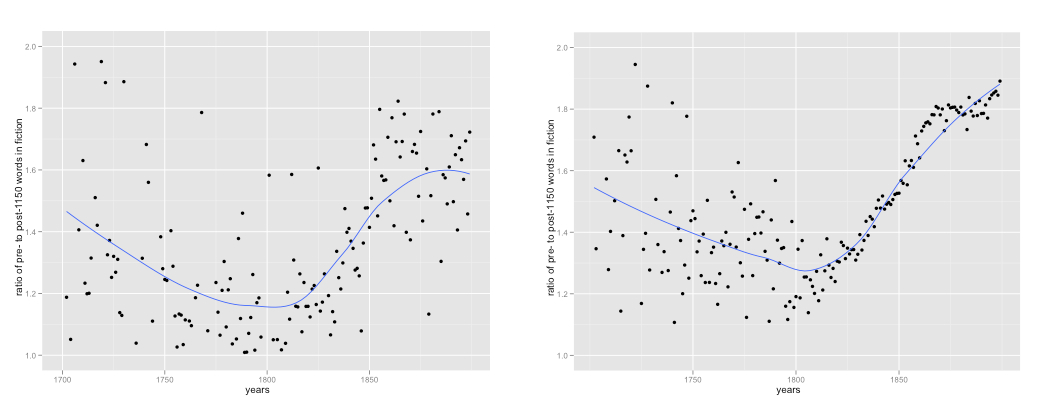
 But the broader point I want to make here is that people pursuing digital research don’t need to agree on a theory of representation in order to cooperate.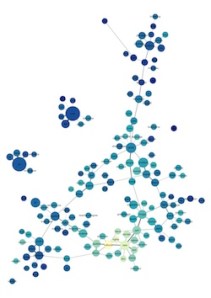
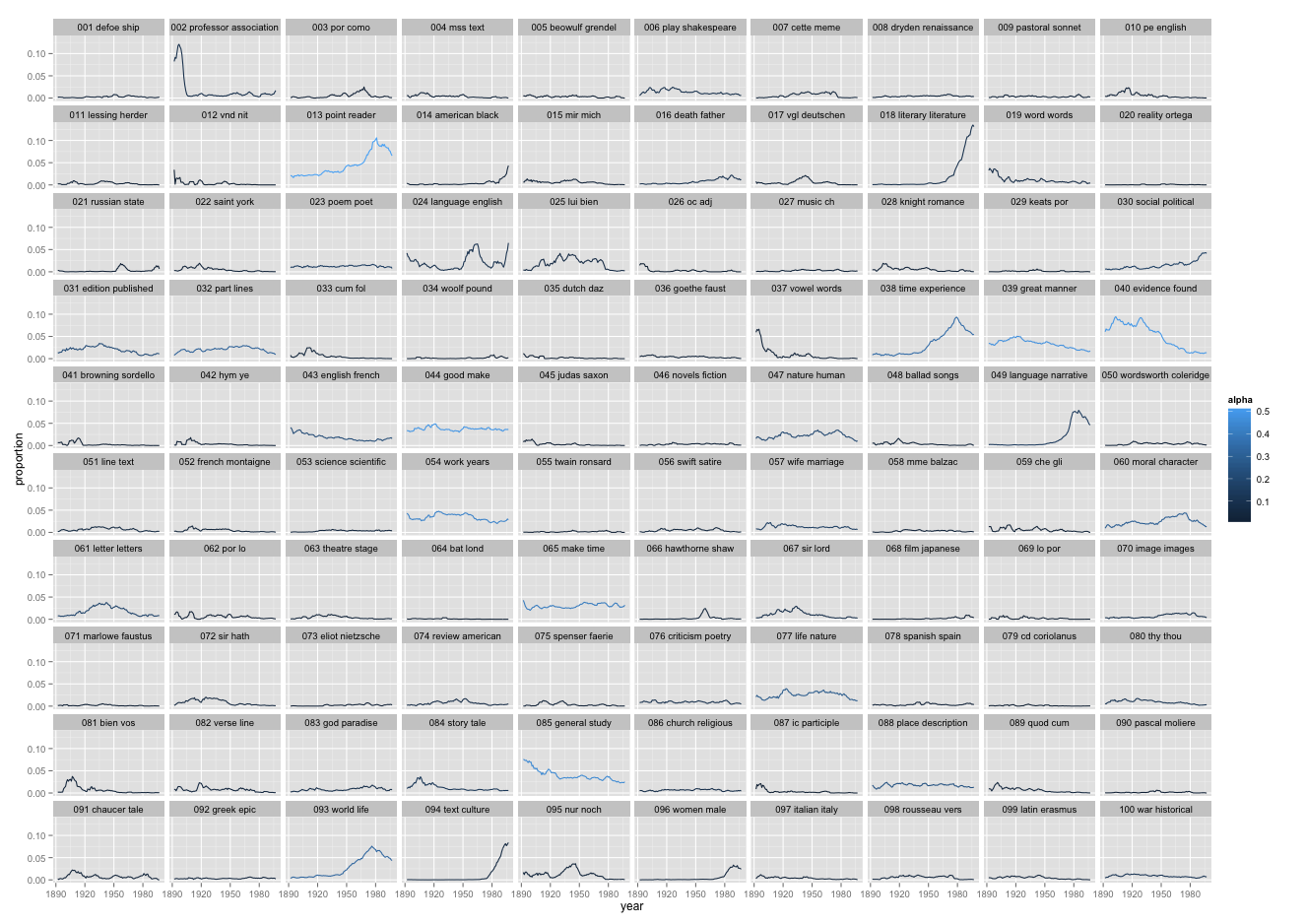
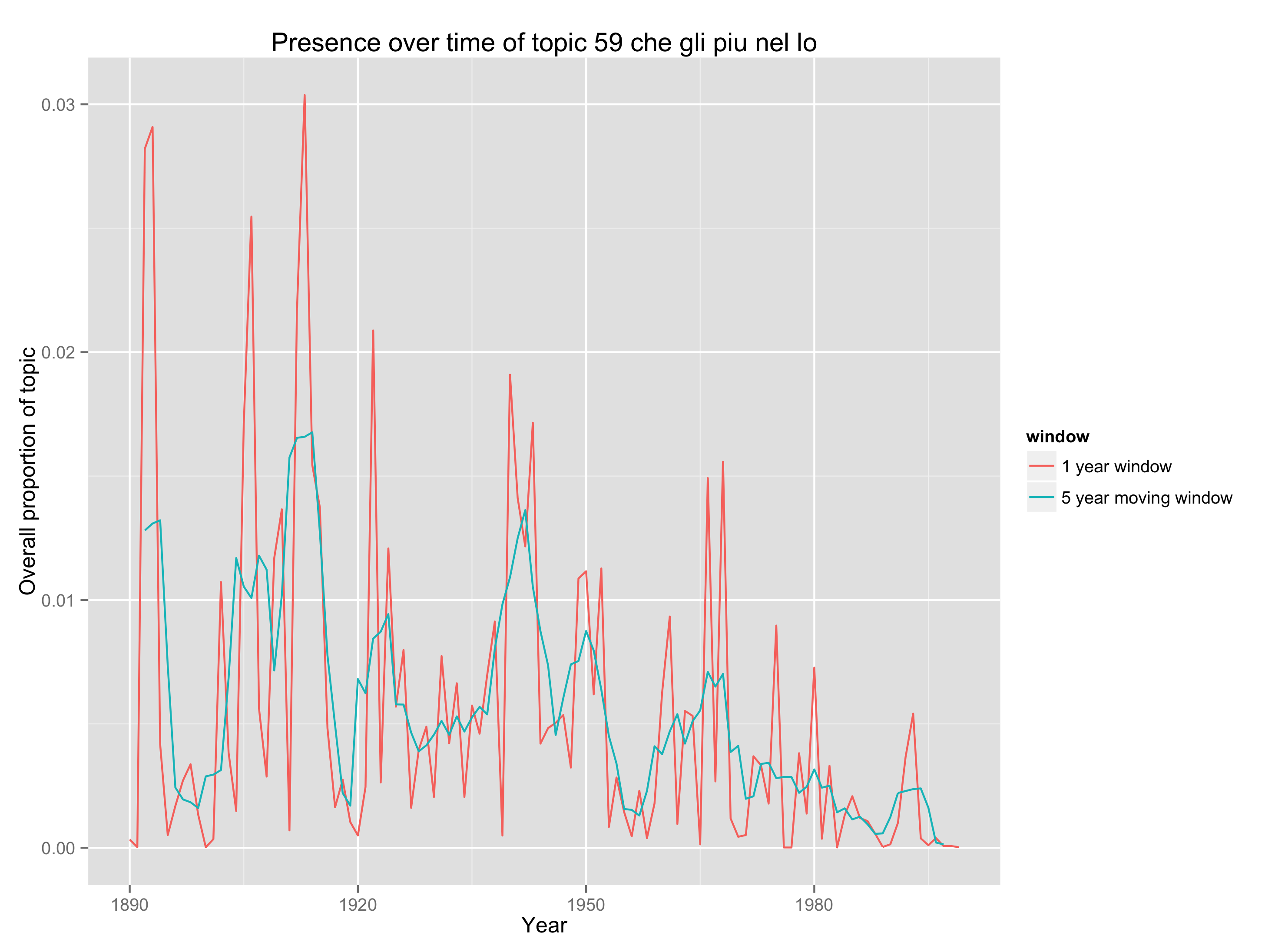
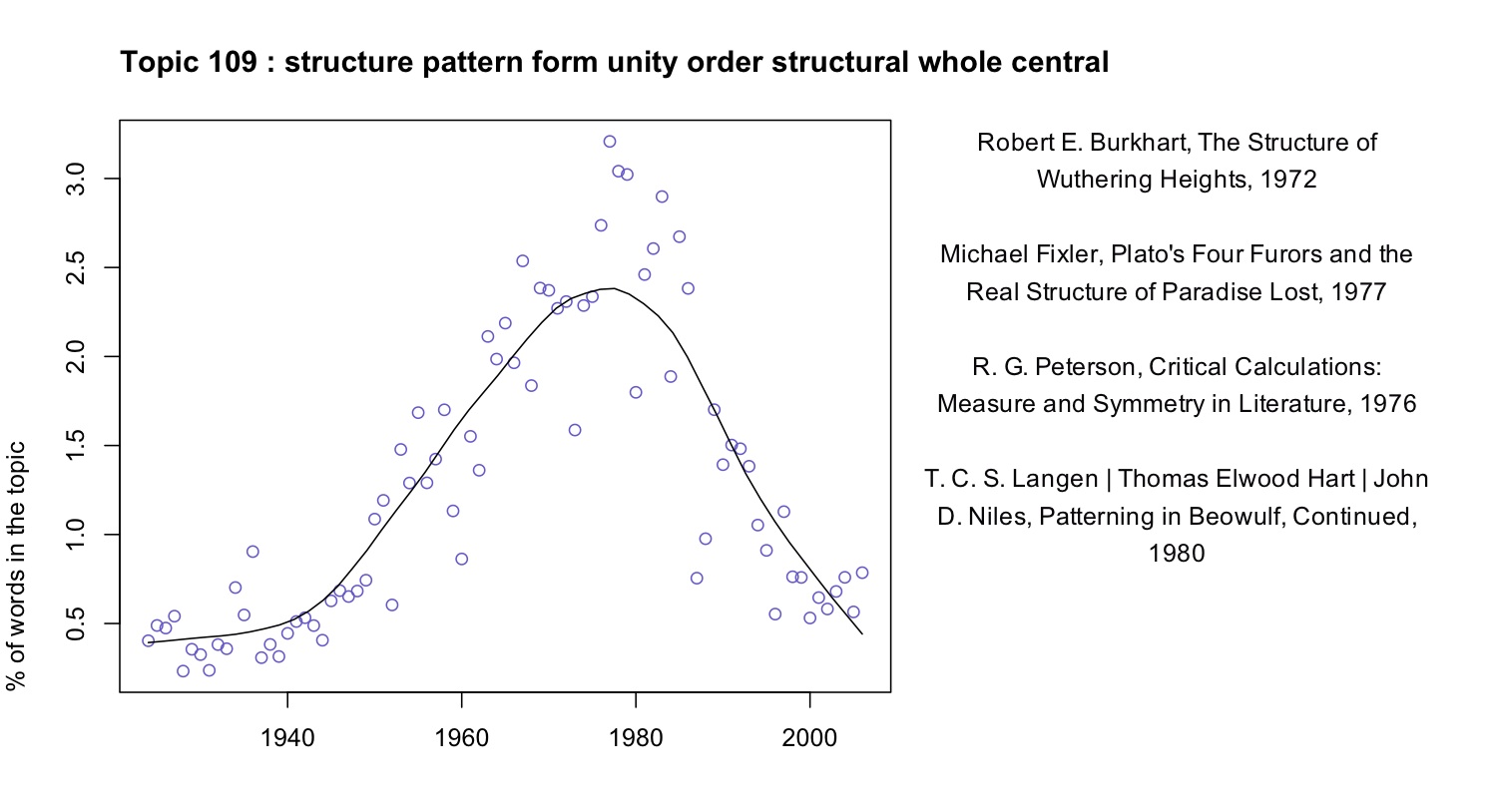
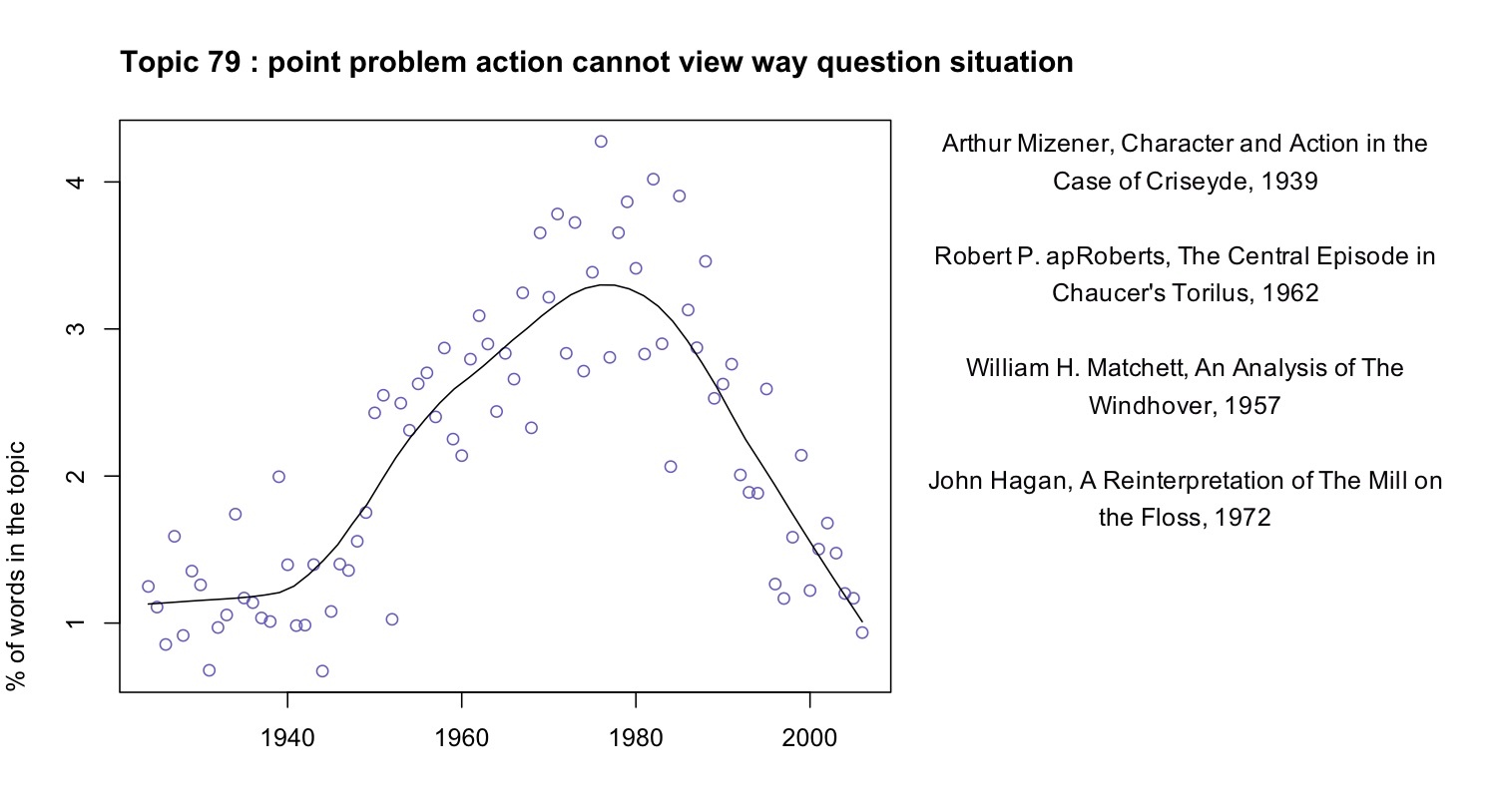
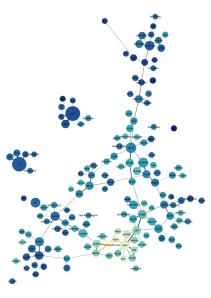

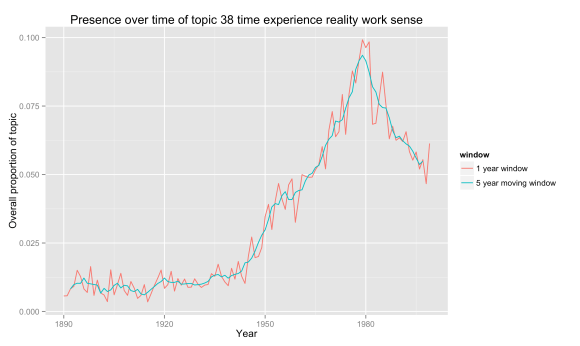
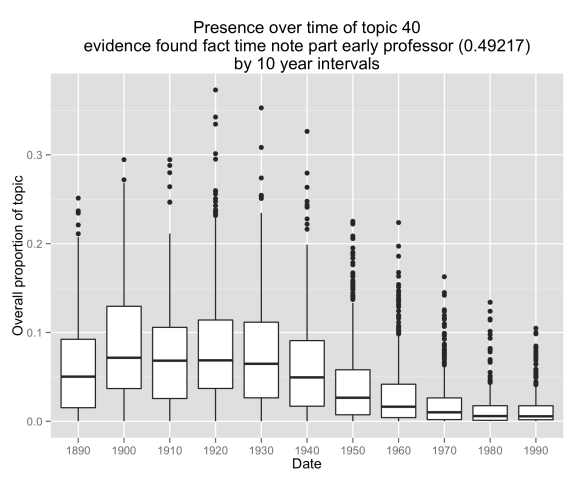
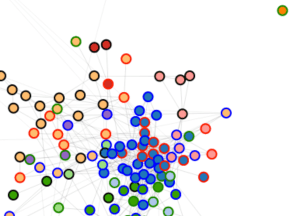
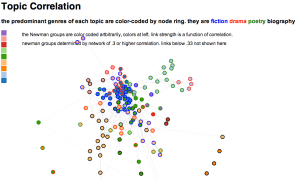

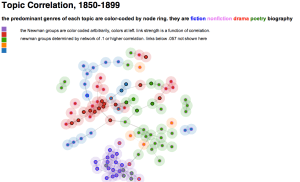
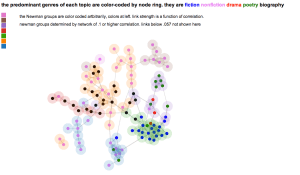
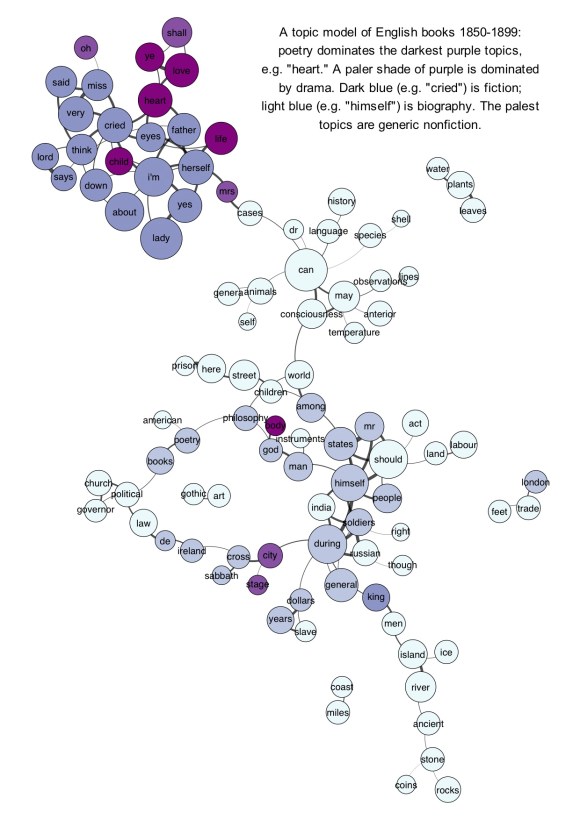

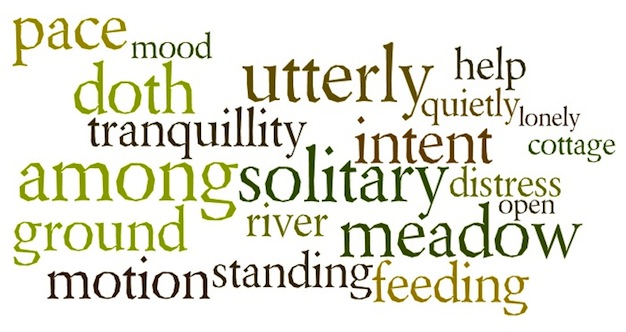


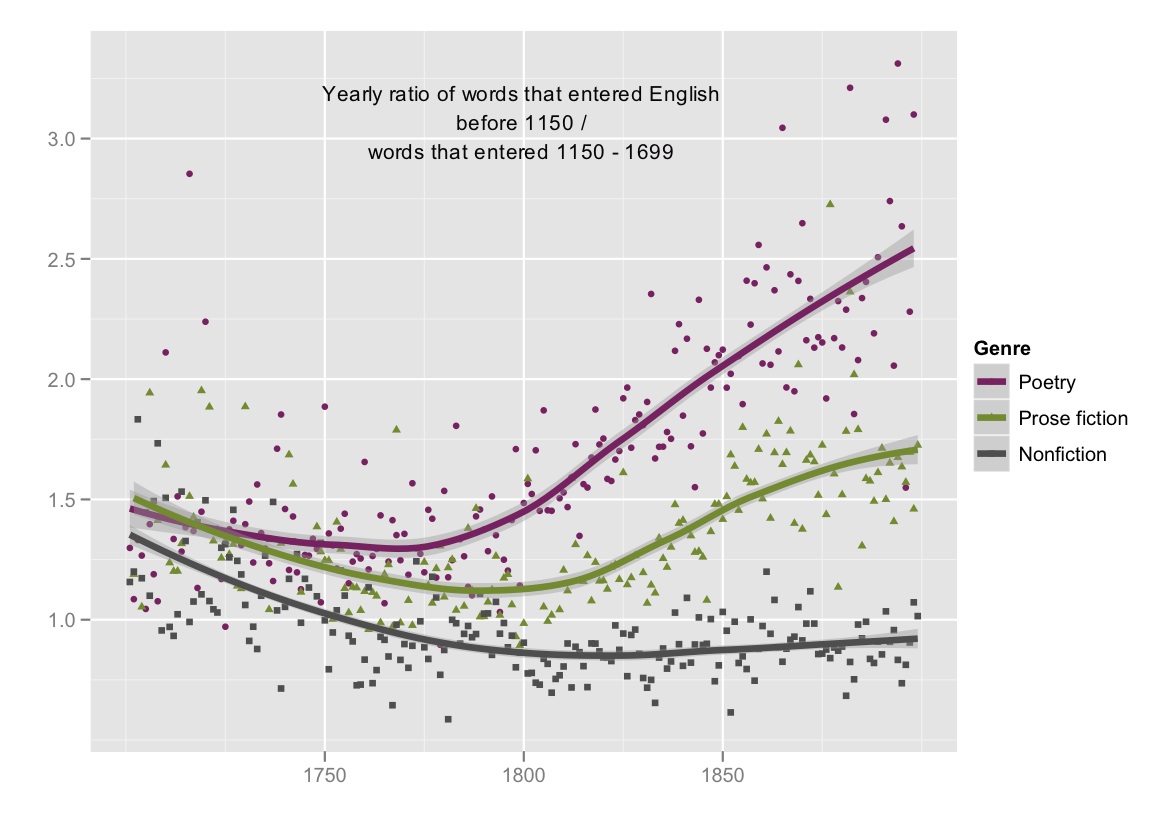
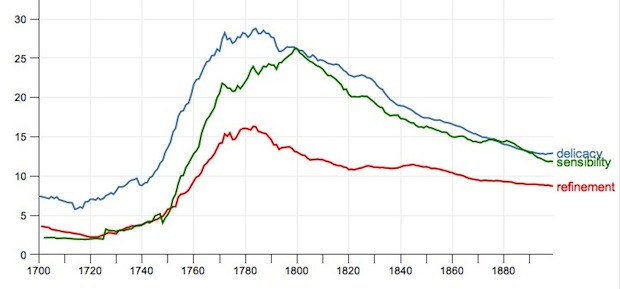
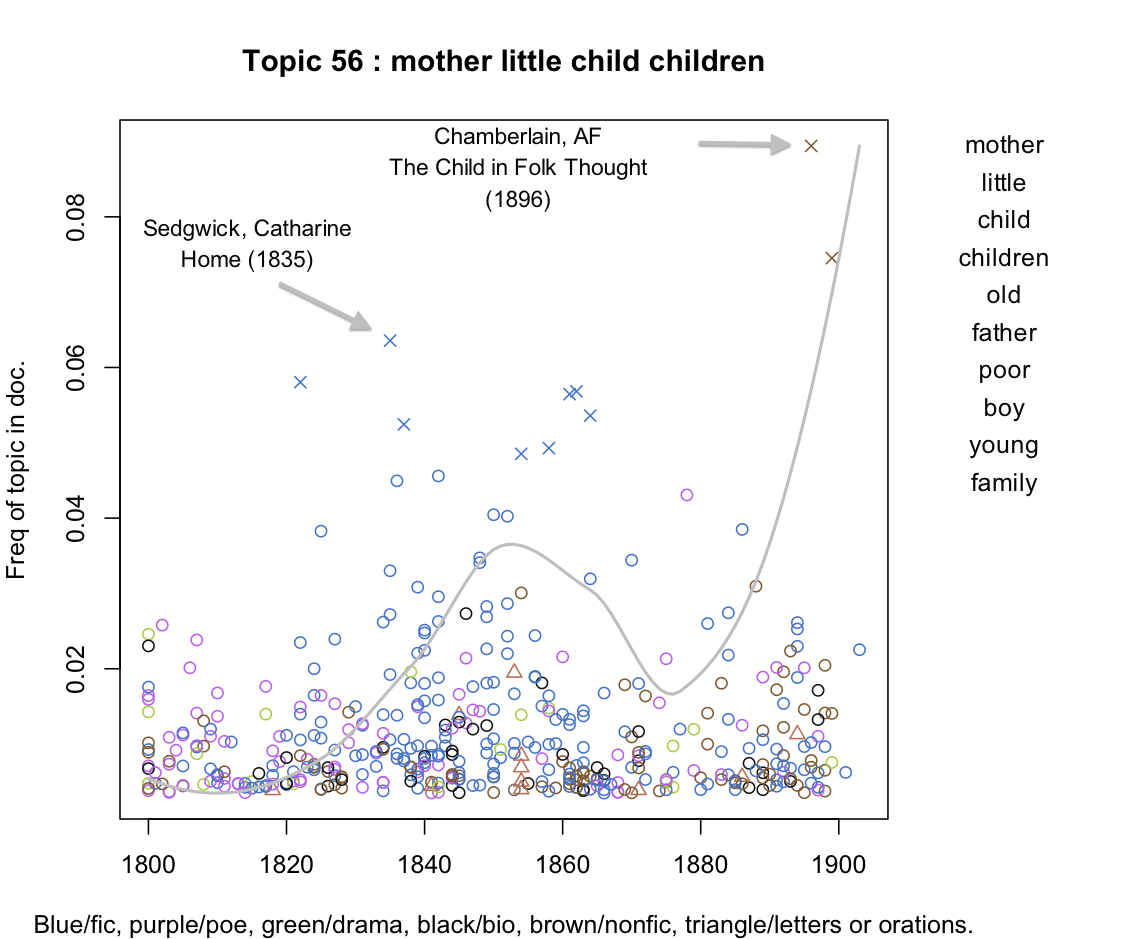


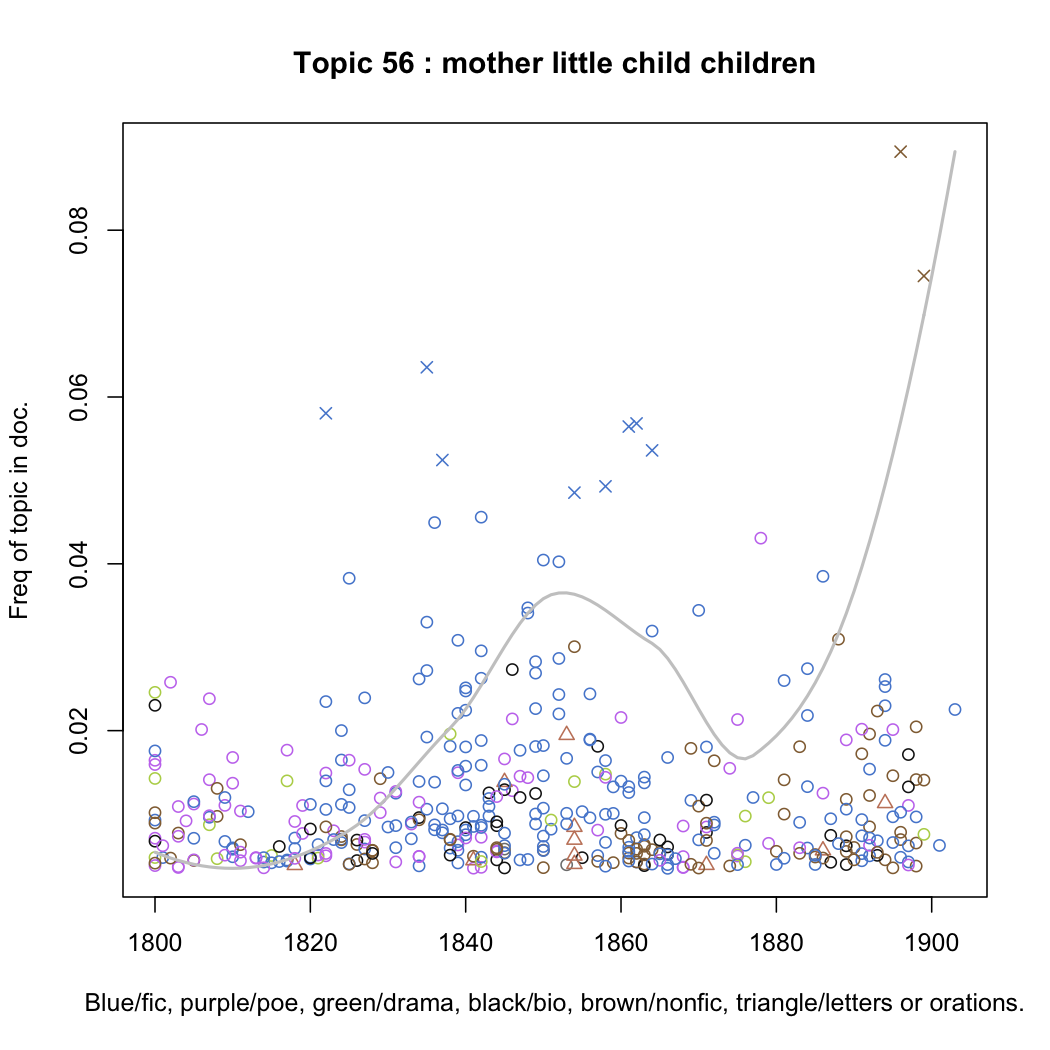
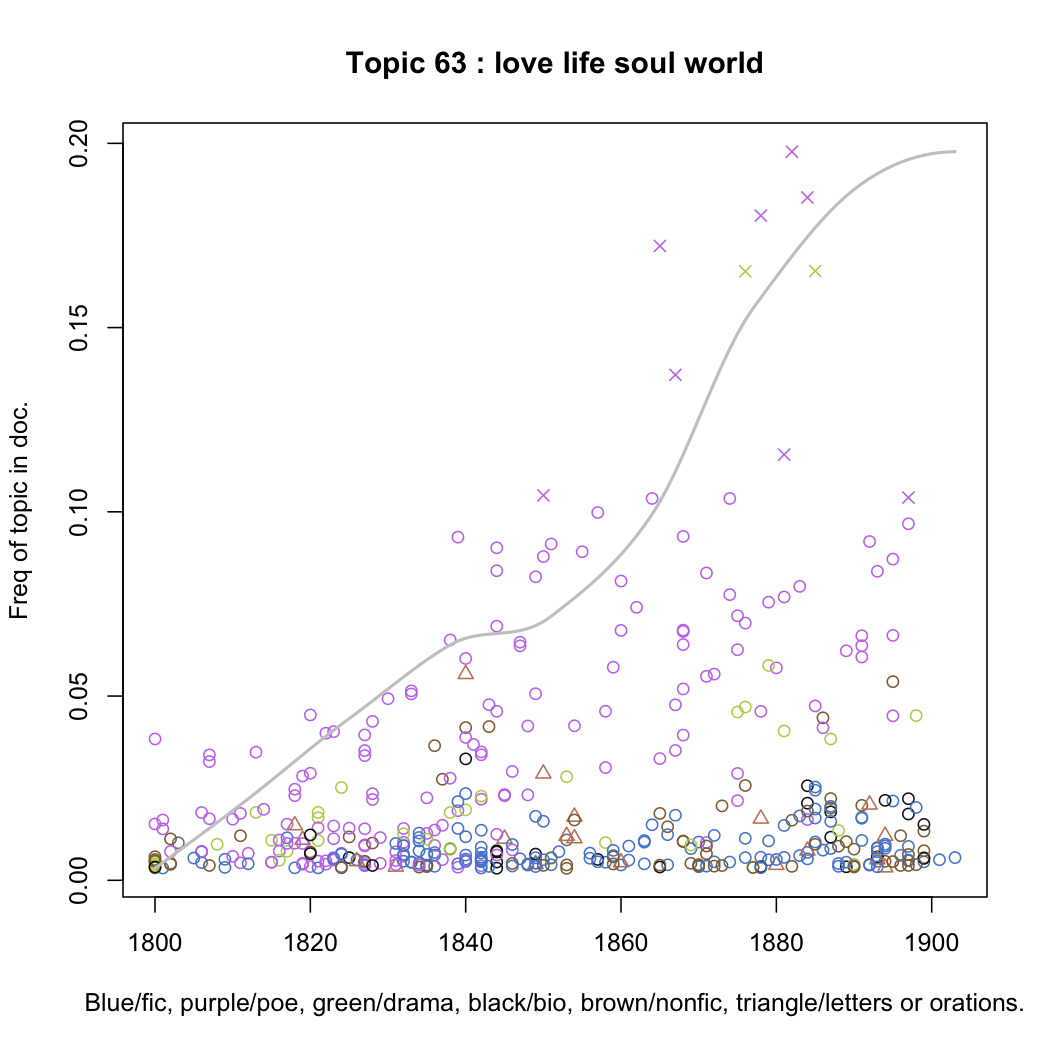
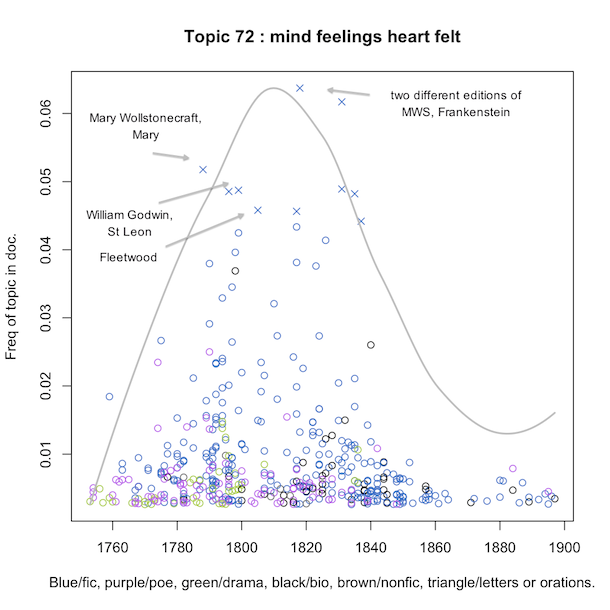

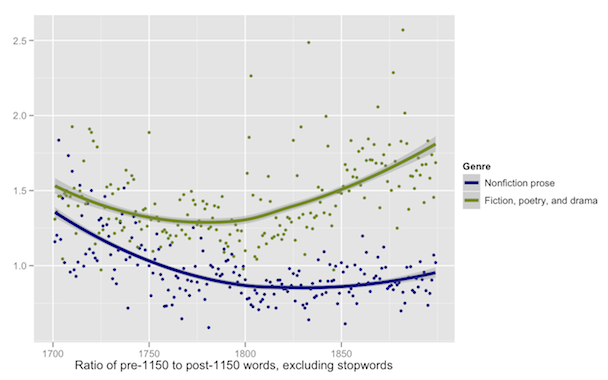
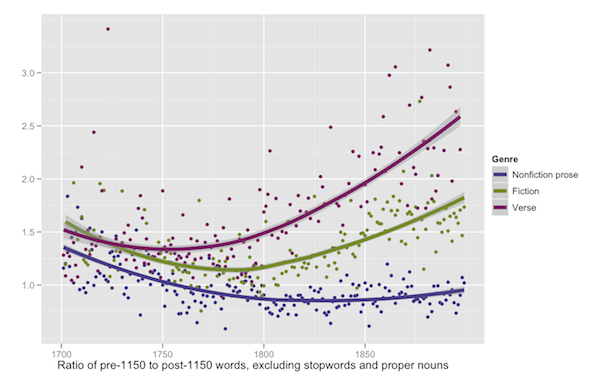

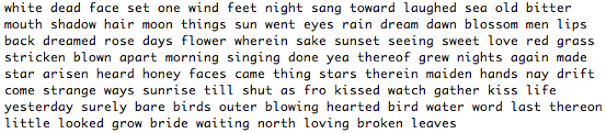
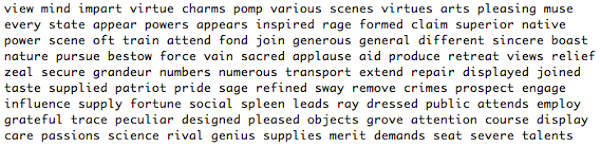
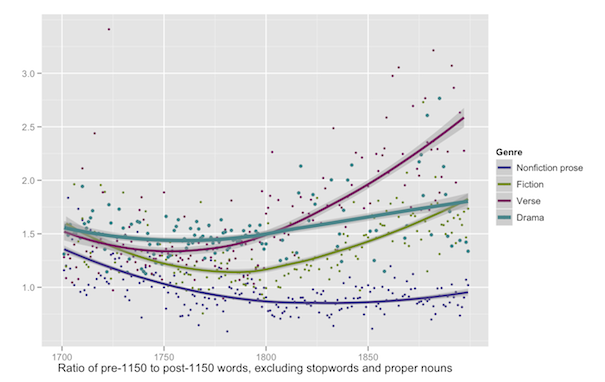
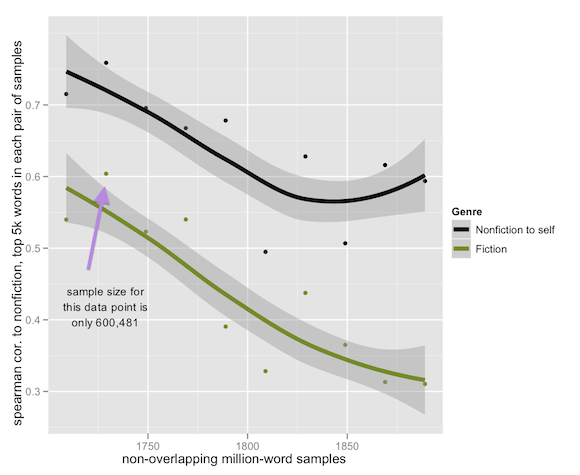
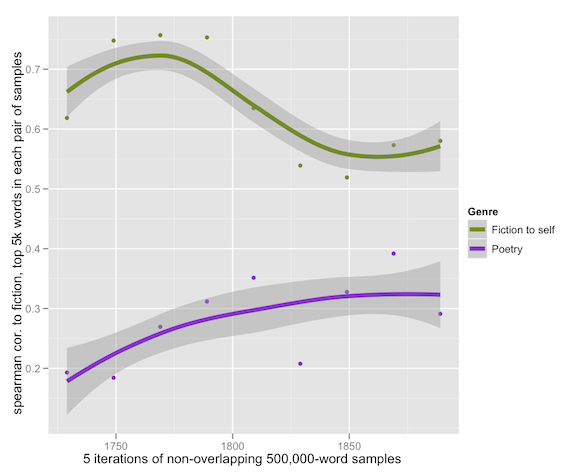
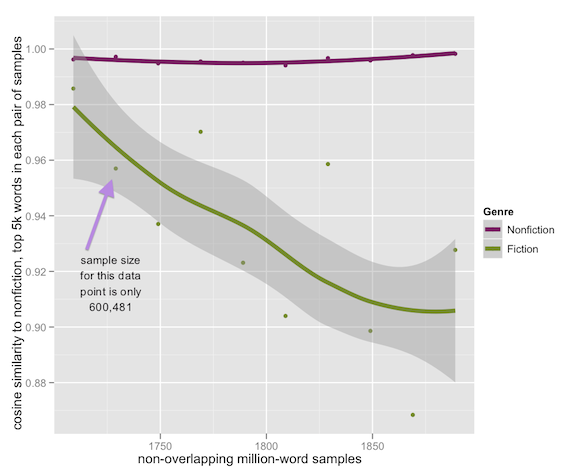
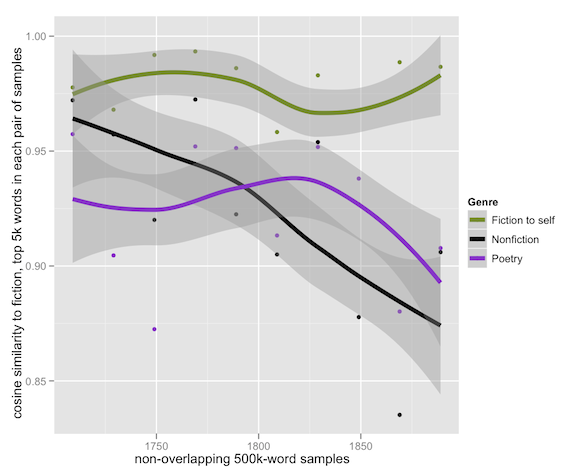
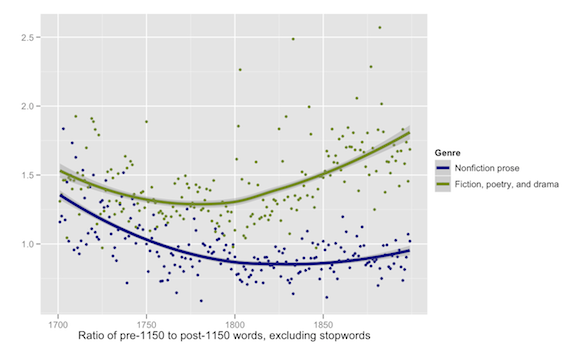
 The Stone and the Shell