Categories
artificial intelligence social effects of machine learning

A more interesting upside of AI

My friends are generally optimistic, forward-looking people, but talking about AI makes many of them depressed. Either AI is scarier than other technologies, or public conversation about it has failed them in some way. Or both.

I think the problem is not just that people have legitimate concerns. What’s weird and depressing about AI discourse right now is the surprising void where we might expect to find a counterbalancing positive vision.

It is not unusual, after all, for new technologies to have a downside. Airplanes were immediately recognized as weapons of war, and we eventually recognized that the CO2 they produce is not great either. But their upside is also vivid: a new and dizzying freedom of motion through three-dimensional space. Is the upside worth the cost? Idk. Saturation bombing has been bad for civilians. But there is at least something in both pans of the scale. It can swing back and forth. So when we think about flight—even if we believe it has been destructive on balance—we can see tension and a possibility of change. We don’t just feel passively depressed.

Is “super-intelligence” the upside for AI?

What people seem to want to put on the “positive” side of the balance for AI is is a 1930s-era dystopia skewered well by Helen De Cruz.

The upside of AI, apparently, is that super-intelligence replaces human agency. This is supposed to have good consequences: accelerating science and so on. But it’s not exactly motivating, because it’s not clear what we get to do in this picture.

Sam Altman’s latest blog post (“The Gentle Singularity”) reassures us by telling us we will always feel there’s something to do. “I hope we will look at the jobs a thousand years in the future and think they are very fake jobs, and I have no doubt they will feel incredibly important and satisfying to the people doing them.”

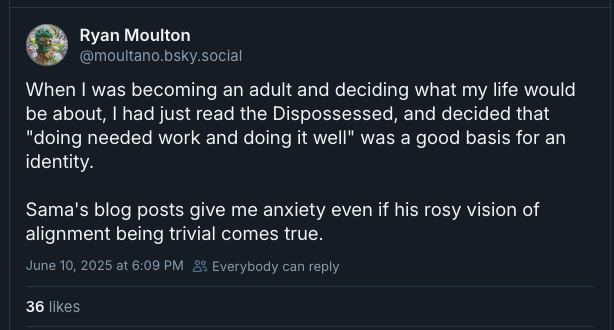
If this is the upside on offer, I’m not surprised people are bored and depressed. First, it’s an unappealing story, as Ryan Moulton explains:

Secondly, as Ryan hints in his last sentence, Altman’s vision of the future isn’t very persuasive. Stories about fully automated societies where superintelligent AI makes the strategic decisions, coordinates the supply chains, &c, quietly assume that we can solve “alignment” not only for models but for human beings. Bipedal primates are expected to naturally converge on a system that allows decisions to be made by whatever agency is smartest or produces best results. Some version of this future has sounded rational and plausible to nerds since Plato. But somehow we nerds consistently fail to make it reality—in spite of our presumably impressive intelligence. If you want a vision of the future of “super-intelligence,” consider the fate of the open web or the NSF.

I’m not just giving a fatalistic shrug about politics and markets here. I think cutting the NSF was a bad idea, but there are good reasons why we keep failing to eliminate human disagreement. It’s a load-bearing part of the system. If you or I tried to automate, say, NSF review panels, our automated system would develop blind spots, and would eventually need external criticism. (For a good explanation of why, see Bryan Wilder’s blog post on automated review.) Conceivably that external criticism could be provided by AI. But if so, the AI would need to be built or controlled by someone else—someone independent of us. If a task is really important, you need legal persons who can’t edit or delete each other arguing over it.

AI as a cultural technology

The irreducible centrality of human conflict is one reason why I doubt that “super-intelligence” is the right frame for thinking about economic and social effects of AI. However smart it gets, a system that lacks independent legal personhood is not a good substitute for a human reviewer or manager. Nor do I think it’s likely that fractious human polities will redefine legal personhood so it can be multiplied by hitting command-C followed by command-V.

A more coherent positive picture of a future with AI has started to emerge. As the title of Ethan Mollick’s Co-Intelligence implies, it tends to involve working with AI assistance, not resigning large sectors of the economy to a super-intelligence. I’ve outlined one reason to expect that path above. Arvind Narayanan and Sayash Kapoor have provided a more sustained argument that AI capability is unlikely to exponentially exceed human capability across a wide range of tasks.

One reason they don’t expect that trajectory is that the recent history of AI has not tended to support assumptions about the power of abstract and perfectly generalizable intelligence. Progress was rapid over the last ten years—but not because we first discovered the protean core of intelligence itself, which then made all merely specific skills possible. Instead, models started with vast, diverse corpora of images and texts, and learned how to imitate them. This approach was frustrating enough to some researchers that they dismissed the new models as mere “parrots,” entities that fraudulently feign intelligence by learning a huge repertoire of specific templates.

A somewhat more positive response to this breakthrough, embraced by Henry Farrell, Alison Gopnik, Cosma Shalizi, and James Evans, has been to characterize AI as a “cultural technology.” Cultural technologies work by transmitting and enacting patterns of behavior. Other examples might include libraries, the printing press, or language itself.

Is this new cultural technology just a false start or a consolation prize in a hypothetical race whose real goal is still the protean core of intelligence? Many AI researchers seem to think so. The term “AGI” is often used. Some researchers, like Yann LeCun, argue that getting to AGI will require a radically different approach. Others suspect that transformer models or diffusion models can do it with sufficient scale.

I don’t know who’s right. But I also don’t care very much. I’m not certain I believe in absolutely general intelligence—and I know that I don’t believe culture is a less valuable substitute for it.

On the contrary. I’m fond of Christopher Manning’s observation that, where sheer intelligence is concerned, human beings are not orders of magnitude different from bonobos. What gave us orders of magnitude greater power to transform this planet, for good or ill, was language. Language vastly magnified our ability to coordinate patterns of collective behavior (culture), and transmit those patterns to our descendants. Writing made cultural patterns even more durable. Now generative language models (and image and sound models) represent another step change in our ability to externalize and manipulate culture.

Why “cultural technology” doesn’t make anyone less depressed

I’ve suggested that a realistic, potentially positive vision of AI has started to coalesce. It involves working with AI as a “normal technology” (Naranayan and Kapoor), one in a long sequence of “cultural technologies” (Gopnik, Farrell, et al) that have extended the collective power of human beings.

So why are my friends still depressed?

Well, if they think the negative consequences of AI will outweigh positive effects, they have every right to be depressed, because no one has proven that’s wrong. It is absolutely still possible that AI will displace people from existing jobs, force retraining, increase concentration of power, and (further) destabilize democracy. I don’t think anyone can prove that the upside of AI outweighs those possible downsides. The cultural and political consequences of technology are hard to predict, and we are not generally able to foresee them at this stage.

French aviator Louis Paulhan flying over Los Angeles in 1910. Library of Congress.

But as I hinted at the beginning of this post, I’m not trying to determine whether AI is good or bad on balance. It can be hard to reach consensus about that, even with a technology as mature as internal combustion or flight. And, even with very mature technologies, it tends to be more useful to try to change the balance of effects than to debate whether it’s currently positive.

So the goal of this post is not to weigh costs and benefits, or argue with skeptics. It is purely to sharpen our sense of the potential upside latent in a vision of AI as “cultural technology.” I think one reason that phrase hasn’t cheered anyone up is that it has been perceived as a deflating move, not an inspiring one. The people disposed to be interested in AI mostly got hooked by a rather different story, about protean general intelligences closely analogous to human beings. If you tell AI enthusiasts “no, this is more like writing,” they tend to get as depressed as the skeptics. My goal here is to convince people who use AI that “this is like writing” is potentially exciting—and to specify some of the things we would need to do to make it exciting.

Mapping and editing culture

So what’s great about writing? It is more durable than the spoken word, of course. But just as importantly, writing allows us to take a step back from language, survey it, fine-tune it, and construct complex structures where one text argues with two others, each of which footnotes fifty others. It would be hard to imagine science without the ability writing provides to survey language from above and use it as building material.

Generative AI represents a second step change in our ability to map and edit culture. Now we can manipulate, not only specific texts and images, but the dispositions, tropes, genres, habits of thought, and patterns of interaction that create them. I don’t think we’ve fully grasped yet what this could mean.

I’ll try to sketch one set of possibilities. But I know in advance that I will fail here, just as someone in 1470 would have failed to envision the scariest and most interesting consequences of printing. At least maybe we’ll get to the point of seeing that it’s not mostly “cheaper Bibles.”

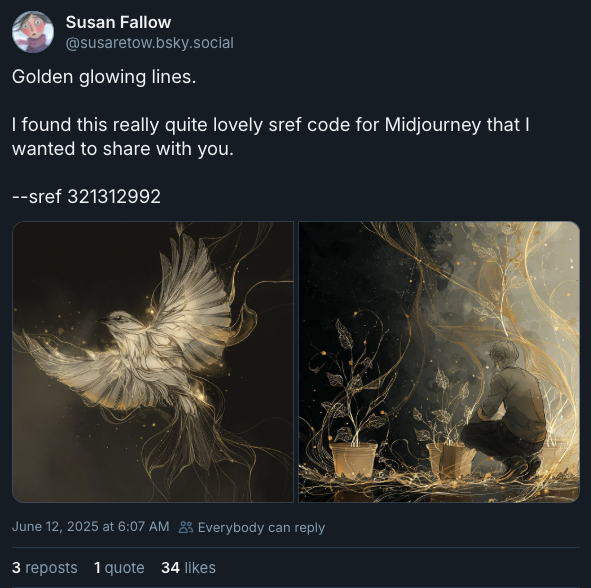
Here’s a Bluesky post that used generative AI to map the space of potential visual styles using a “style reference” (sref).

In the early days of text-to-image models, special phrases were passed around like magic words. Adding “Unreal Engine” or “HD” or “by James Gurney” produced specific stylistic effects. But the universe of possible styles is larger than a dictionary of media, artistic schools, or even artists’ names can begin to cover. If we had a way to map that universe, we could explore blank spaces on the map.

Midjourney invented “style references” as simple way to do that. You create a reference by choosing between pairs of images that represent opposing vectors in a stylistic plane. In the process of making those choices, you construct your own high-dimensional vector. Once you have a code for the vector, you can use it as an newly invented adjective, and dial its effect up or down.

A map with just a touch of the style shared above by Susan Fallow, which adds (among other things) traces that look like gilding. (“an ancient parchment map showing the coastline of an imagined world –sref 321312992 –sv 4 –sw 20 –ar 2:1“)

“Style references” are modest things, of course. But if we can map a space of possibility for image models, and invent new adjectives to describe directions in that space, we should be able to do the same for language models.

And “style” is not the only thing we could map. In exploring language, it seems likely that we will be mapping different ways of thinking. The experiment called “Golden Gate Claude” was an early, crude demonstration of what this might mean. Anthropic mapped the effect of different neurons in a model, and used that knowledge to tune up one neuron and create a version of Claude deeply obsessed with the Golden Gate Bridge. Given any topic, it would eventually bring the conversation around to fog, or the movie Vertigo — which would remind it, in turn, of San Francisco’s iconic Golden Gate Bridge.

Golden Gate Claude was more of a mental illness than a practical tool. (It reminded me of Vertigo in more than one sense.) But making the model obsessed with a specific landmark was a deliberate simplification for dramatic effect. Anthropic’s map of their model had a lot more nuance available, if it had been needed.

From “Scaling Monosemanticity: Extracting Interpretable Features from Claude 3 Sonnet”

The image above is map of conceptual space based on neurons in a single model. You could think of it as a map of a single mind, or (if you prefer) a single pattern of language use. But models also differ from each other, and there’s no reason why we need to be limited to considering one at a time.

Academics working in this space (both in computer science and in the social sciences) are increasingly interested in using language models to explore cultural pluralism. As we develop models trained on different genres, languages, or historical periods, these models could start to function as reference points in a larger space of cultural possibility that represents the differences between maps like the one above. It ought to be possible to compare different modes of thought, edit them, and create new adjectives (like style references) to describe directions in cultural space.

If we can map cultural space, could we also discover genuinely new cultural forms and new ways of thinking? I don’t know why not. When writing was first invented it was, obviously, a passive echo of speech. “It is like a picture, which can give no answer to a question, and has only a deceitful likeness of a living creature” (Phaedrus).

But externalizing language, and fixing it in written marks, eventually allowed us to construct new genres (the scientific paper, the novel, the index) that required more sustained attention or more mobility of reference than the spoken word could support. Models of culture should similarly allow us to explore a new space of human possibility by stabilizing points of reference within it.

Wait, is editing culture a good idea?

“A new ability to map and explore different modes of reasoning” may initially sound less useful than a super-intelligence that just produces the right answer to our problems. And, look, I’m not suggesting that mapping culture is the only upside of AI. Drug discovery sounds great too! But if you believe human conflict is our most important and durable problem, then a technology that could improve human self-understanding might eventually outweigh a million new drugs.

I don’t mean that language models will eliminate conflict. I said above that conflict is a load-bearing part of society. And language models are likely to be used as ideological weapons—just as pamphlets were, after printing made them possible. But an ideological weapon that can be quizzed and compared to other ideologies implies a level of putting-cards-on-the-table beyond what we often get in practice now. There is at least a chance, as we have seen with Grok, that people who try to lie with an interactive model will end up exposing their own dishonest habits of thought.

So what does this mean concretely? Will maps of cultural space ever be as valuable economically as personal assistants who can answer your email and sound like Scarlett Johansson?

Probably not. Using language models to explore cultural space may not be a great short-term investment opportunity. It’s like — what would be a good analogy? A little piece of amber that, weirdly, attracts silk after rubbing. Or, you know, a little wheel containing water that spins when you heat it and steam comes out the spouts. In short, it is a curiosity that some of us will find intriguing because we don’t yet understand how it works. But if you’re like me, that’s the best upside imaginable for a new technology.

Wait. You’ve suggested that “mapping and editing culture” is a potential upside of AI, allowing us to explore a new space of human potential. But couldn’t this power be misused? What if the builders of Grok don’t “expose their own dishonesty,” but successfully manipulate the broader culture?

Yep, that could happen. I stressed earlier that this post was not going to try to weigh costs against benefits, because I don’t know—and I don’t think anyone knows—how this will play out. My goal here was “purely to sharpen our sense of the potential upside of cultural technology,” and help “specify what we would need to do to make it exciting.” I’m trying to explain a particular challenge and show how the balance could swing back and forth on it. A guarantee that things will, in fact, play out for the best is not something I would pretend to offer.

A future where human beings have the ability to map and edit culture could be very dark. But I don’t think it will be boring or passively depressing. If we think this sounds boring, we’re not thinking hard enough.

References

Altman, S. (2025, June 10). The Gentle Singularity. Retrieved July 2, 2025, from https://blog.samaltman.com/the-gentle-singularity blog.samaltman.com

Anthropic Interpretability Team. (2024, April). Scaling monosemanticity: Extracting interpretable features from Claude 3 Sonnet. Transformer Circuits Thread. Retrieved July 2, 2025, from https://transformer-circuits.pub/2024/scaling-monosemanticity/index.html

Bender, E. M., Gebru, T., McMillan-Major, A., & Shmitchell, S. (2021). On the dangers of stochastic parrots: Can language models be too big? In Proceedings of the 2021 ACM Conference on Fairness, Accountability, and Transparency (pp. 610–623). Association for Computing Machinery. https://doi.org/10.1145/3442188.3445922 researchgate.net

Farrell, H., Gopnik, A., Shalizi, C., & Evans, J. (2025, March 14). Large AI models are cultural and social technologies. Science, 387(6739), 1153–1156. https://doi.org/10.1126/science.adt9819 pubmed.ncbi.nlm.nih.gov

Manning, C. D. (2022). Human language understanding & reasoning. Daedalus, 151(2), 127–138. https://doi.org/10.1162/daed_a_01905 virtual-routes.org

Mollick, E. (2024). Co-Intelligence: Living and working with AI. Penguin Random House. penguinrandomhouse.com

Narayanan, A., & Kapoor, S. (2025, April 15). AI as normal technology: An alternative to the vision of AI as a potential superintelligence. Knight First Amendment Institute. kfai-documents.s3.amazonaws.com

Sorensen, T., Moore, J., Fisher, J., Gordon, M., Mireshghallah, N., Rytting, C. M., Ye, A., Jiang, L., Lu, X., Dziri, N., Althoff, T., & Choi, Y. (2024). A roadmap to pluralistic alignment. arXiv. https://arxiv.org/abs/2402.05070

Standard Ebooks. (2022). Phaedrus (B. Jowett, Trans.). Retrieved July 2, 2025, from https://standardebooks.org/ebooks/plato/dialogues/benjamin-jowett/text/single-page

Varnum, M. E. W., Baumard, N., Atari, M., & Gray, K. (2024). Large language models based on historical text could offer informative tools for behavioral science. Proceedings of the National Academy of Sciences of the United States of America, 121(42), e2407639121. https://doi.org/10.1073/pnas.2407639121

Wilder, B. (2025). Equilibrium effects of LLM reviewing. Retrieved July 2, 2025, from https://bryanwilder.github.io/files/llmreviews.html bryanwilder.github.io

Categories
artificial intelligence social effects of machine learning

Will AI make us overconfident?

Several times in the last year I’ve been surprised when students who I thought were still learning to program showed up to our meeting with a fully-formed (good) solution to a challenging research problem.

In part, this is just what it feels like to work with students. “Wait, I thought you couldn’t do that, and now you’re telling me you can do it? You somehow learned to do it?”

But there’s also a specific reason why students are surprising me more often lately. In each of these cases, when my eyes widened, the student minimized their own work by adding “oh, it’s easy with ChatGPT.”

I understand what they mean, because I’m having the same experience. As Simon Willison has put it, “AI-enhanced development makes me more ambitious with my projects.” The effect is especially intense if you code, because AI code completion is like wearing seven-league boots. But it’s not just for coding. Natural-language dialogue with a chatbot also helps me understand new concepts and choose between tools.

As in any fairytale, accepting magical assistance comes with risks. Chatbot advice has saved me several days on a project, but if you add up bugs and mistakes it has cost me at least a day too. And it’s hard to find bugs if you’re not the person who put them in! I won’t try to draw up a final balance sheet here, because a) as tools evolve, the balance will keep changing, and b) people have developed very strong priors on the topic of “AI hallucination” and I don’t expect to persuade readers to renounce them.

Instead, let’s agree to disagree about the ratio of “really helping” to “encouraging overconfidence.” What I want to say in this short post is just that, when it comes to education, even encouraging overconfidence can have positive effects. A lot of learning takes place when we find an accessible entry point to an actually daunting project.

I suspect this is how the internet encouraged so many of us to venture across disciplinary boundaries. I don’t have a study to prove it, but I guess I’ve lived it, because I considered switching disciplines twice in my career. The first attempt, in the 1990s, came to nothing because I started by going to the library and checking out an introductory textbook. Yikes: it had like five hundred pages. By 2010 things were different. Instead of starting with a textbook you could go straight to a problem you wanted to solve and Google around until you found a blog solving a related problem and — hmm — it says you have to download this program called “R,” but how hard can that be? just click here …

As in the story of “Stone Soup,” the ease was mostly deceptive. In fact I needed to back up and learn statistics in order to understand the numbers R was going to give me, and that took a few years more than I expected. But it’s still good for everyone that the interactive structure of the internet has created accessible entry points to difficult problems. Even if the problem is in fact still a daunting monolith … now it has a tempting front door.

In many ways, generative AI is just an extension of a project that the internet started thirty years ago: a project to reorganize knowledge interactively. Instead of starting by passively absorbing a textbook, we can can cobble together solutions from pieces we find in blogs and Stack Overflow threads and GitHub repos. Language models are extensions of this project, of course, in the literal sense that they were trained on Stack Overflow threads and GitHub repos! And I know people have a range of opinions about whether that training counts as fair use.

But let’s save the IP debate for another day. All I want to say right now is that the effects of generative AI are also likely to resemble the effects of the shift toward interactivity that began with the Web. In many cases, we’re not really getting a robot who can do a whole project for us. We’re getting an accessible front door, perhaps in the form of a HuggingFace page, plus a chatty guide who will accompany us inside the monolith and help us navigate the stairs. With this assistance, taking on unfamiliar tasks may feel less overwhelming. But the guide is fallible! So it’s still on us to understand our goal and recognize wrong turns.

Is the net effect of all this going to be good or bad? I doubt anyone knows. I certainly don’t. The point of this post is just to encourage us to reframe the problem a little. Our fears and fantasies about AI currently lean very heavily on a narrative frame where we “prompt it” to “do a task for us.” Sometimes we get angry—as with the notorious “Dear Sydney” ad—and insist that people still need to “do that for themselves.”

While that’s fair, I’d suggest flipping the script a little. Once we get past the silly-ad phase of adjusting to language models, the effect of this technology may actually be to encourage people to try doing more things for themselves. The risk is not necessarily that AI will make people passive; in fact, it could make some of us more ambitious. Encouraging ambition has upsides and downsides. But anyway, “automation” might not be exactly the right word for the process. I would lean instead toward stories about seven-league boots and animal sidekicks who provide unreliable advice.*


(* PS: For this reason, I think the narrator/sidekick in Robin Sloan’s Moonbound may provide a better parable about AI than most cyberpunk plots that hinge on sublime/terrifying/godlike singularities.)

Categories
artificial intelligence machine learning Uncategorized

Should artificial intelligence be person-shaped?

Since Mary Shelley, writers of science fiction have enjoyed musing about the moral dilemmas created by artificial persons.

I haven’t, to be honest. I used to insist on the term “machine learning,” because I wanted to focus on what the technology actually does: model data. Questions about personhood and “alignment” felt like anthropocentric distractions, verging on woo.

But these days woo is hard to avoid. OpenAI is now explicitly marketing the promise that AI will cross the uncanny valley and start to sound like a person. The whole point of the GPT-4o demo was to show off the human-sounding (and um, gendered) expressiveness of a new model’s voice. If there had been any doubt about the goal, Sam Altman’s one-word tweet “her” removed it.

Mira Murati, Mark Chen, and Barret Zoph at the GPT-4o demo.

At the other end of the spectrum lies Apple, which seems to be working hard to avoid any suggestion that the artificial intelligence in their products could coalesce into an entity. The phrase “Apple Intelligence” has a lot of advantages, but one of them is that it doesn’t take a determiner. It’s Apple Intelligence, not “an apple intelligence.” Apple’s conception of this feature is more like an operating system — diffuse and unobtrusive — just a transparent interface to the apps, schedules, and human conversations contained on your phone.

Craig Federighi at WWDC ’24. If you look closely, Apple Intelligence includes “a more personal Siri.” But if you look even closer, the point is not that Siri has more personhood but that it will better understand yours (e.g., when your mother’s flight arrives).

If OpenAI is obsessed with Her, Apple Intelligence looks more like a Caddy from All the Birds in the Sky. In Charlie Jane Anders’ novel, Caddies are mobile devices that quietly guide their users with reminders and suggestions (restaurants you might like, friends who happen to be nearby, and so on). A Caddy doesn’t need an expressive voice, because it’s a service rather than a separate person. In All the Birds, Patricia starts to feel it’s “an extension of her personality” (173).

There are a lot of reasons to prefer Apple’s approach. Putting the customer at the center of a sales pitch is usually a smart move. Ben Evans also argues that users will understand the limitations of AI better if it’s integrated into interfaces that provide a specific service rather than presented as an open-ended chatbot.

Moreover, Apple’s approach avoids several kinds of cringe invited by OpenAI’s demo — from the creepily-gendered Pygmalion vibe to the more general problem that we don’t know how to react to the laughter of a creature that doesn’t feel emotion. (Readers of Neuromancer may remember how much Case hates “the laugh that wasn’t laughter” emitted by the recording of his former teacher, the Dixie Flatline.)

Finally, impersonal AI is calculated to please grumpy abstract thinkers like me, who find a fixation on so-called “general” intelligence annoyingly anthropocentric.

However. Let’s look at the flip side for a second.

The most interesting case I’ve heard for person-shaped AI was offered last week by Amanda Askell, a philosopher working at Anthropic. In an interview with Stuart Richie, Askell argues that AI needs a personality for two reasons. First, shaping a personality is how we endow models with flexible principles that will “determine how [they] react to new and difficult situations.” Personality, in other words, is simply how we reason about character. Second, personality signals to users that they’re not talking to an omniscient oracle.

“We want people to know that they’re interacting with a language model and not a person. But we also want them to know they’re interacting with an imperfect entity with its own biases and with a disposition towards some opinions more than others. Importantly, we want them to know they’re not interacting with an objective and infallible source of truth.”

It’s a good argument. One has to approach it skeptically, because there are several other profitable reasons for companies to give their products a primate-shaped UI. It provides “a more interesting user experience,” as Askell admits — and possibly a site of parasocial attachment. (OpenAI’s Sky voice sounded a bit like Scarlett Johansson.) Plus, human behavior is just something we know how to interpret. I often prefer to interact with ChatGPT in voice mode, not only because it leaves my hands and eyes free, but because it gives the model an extra set of ways to direct my attention — ranging from emphasis to, uh, theatrical pauses that signal a new or difficult topic.

But this ends up sending us back to Askell’s argument. Even if models are not people, maybe we need the mask of personality to understand them? A human-sounding interface provides both simple auditory signals and epistemic signals of bias and limitation. Suppressing those signals is not necessarily more honest. It may be relevant here that the impersonal transparency of the Caddies in All the Birds in the Sky turns out to be a lie. No spoilers, but the Caddies actually have an agenda, and are using those neutral notifications and reminders to steer their human owners. It wouldn’t be shocking if corporate interfaces did the same thing.

So, should we anthropomorphize AI? I think it’s a much harder question than is commonly assumed, and maybe not a question that can be answered at all. Apple and Anthropic are selling different products, to different audiences. There’s no reason one of them has to be wrong.

On Bluesky, Dave Palfrey reminds me that the etymology of “person” leads back through “fictional character” to “mask.”

More fundamentally, this is a hard question because it’s not clear that we’re telling the full truth when we anthropomorphize people. Writers and critics have been arguing for a long time that the personality of the author is a mask. As Stéphane Mallarmé puts it, “the pure work implies the disappearance of the poet speaking, who yields the initiative to words” (208). There’s a sense in which all of us are language models. “How do I know what I think until I see what I say?”

This shoggoth could also be captioned “language,” and the mask could be captioned “personality.” Authorship of the image not 100% clear; see the full history of this meme.

So if we feel creeped out by all the interfaces for artificial intelligence — both those that pretend to be neutrally helpful and those that pretend to laugh at our jokes — the reason may be that this dilemma reminds us of something slightly cringe and theatrical about personality itself. Our selves are not bedrock atomic realities; they’re shaped by collective culture, and the autonomy we like to project is mostly a fiction. But it’s also a necessary fiction. Projecting and perceiving personality is how we reason about questions of character and perspective, and we may end up trusting models more if they can play the same game. Even if we flinch a little every time they laugh.

References

Anders, Charlie Jane. All the Birds in the Sky. Tor, 2016.

Askell, Amanda and Richie, Stuart. “What should an AI’s personality be?” Anthropic blog. June 8, 2024.

Gibson, William. Neuromancer. Ace, 1984.

Mallarmé, Stéphane. “The Crisis of Verse.” In Divagations, trans Barbara Johnson. Harvard University Press, 2007.

Warner Bros. Picture presents an Annapurna Pictures production; produced by Megan Ellison, Spike Jonze, Vincent Landay; written and directed by Spike Jonze. Her. Burbank, CA: Distributed by Warner Home Video, 2014.